Genuine well being for ourselves and the planet

Imagine my surprise, while attending a national Happiness Conference in Seattle, to find the soundtrack in my head was from “Pete’s Dragon,” a 1977 Walt Disney movie.  The particular song looping repeatedly through my brain was “There’s Room For Everyone,” which asserts:

“There’s room for everyone in this world
Back up and make some room
Let’s all move over and share this world
Everyone make some room

Just think how far out the ocean goes, the whirling wind blows
Shore to shore, door to door.
Think of the valleys, the mountaintops, the Earth never stops.
So deep so high, with miles of sky, we all have part of the pie.”

Flowers with a friend at Pike Place market in Seattle.

In the film, the pie was about sharing small town life with — you guessed it — a loveable but lonely dragon.  In Seattle, at the conference sponsored by the Happiness Initiative last weekend, the “pie” was a great deal bigger: the happiness movement itself.  Indeed, “big” scarcely scratches the surface of describing our efforts to shift the dominant cultural paradigm away from the environment-destroying GDP definition of success and toward a life-enhancing Gross National Happiness metric instead.  There’s definitely room for everyone in this movement!

And just what will everyone do?  Heeding the wisdom of Martin Seligman, I suggest we each tap into our personal strengths and do whatever it is we each do best.  The diversity of speakers at the conference’s plenary session — from renowned ecological economist Robert Costanza to representatives from the Compassionate Action Network and the hardworking staff of the Happiness Initiative — collectively demonstrated that there are probably an infinite number of doorways into this work.  Why not pick the path that plays to our strengths?

Of course, the speakers and presenters were only a fraction of the amazing people and energy gathered together at Seattle University.  Here are a few others I met:

  • Pete, a very smiley Bangkok student now planning to lead a Happiness Initiative at the University of Michigan;
  • Mike, a media expert on hand to discuss socially responsible ways to market the happiness movement;
  • Maureen from Missouri, a new grandmother and determined activist for the “Take Back Your Time” cause;
  • Barb, a colorful individual who leads “Spirals of Joy” workshops in Eugene, Oregon; and
  • Justin, a young Japanese-American musician specializing in Brazilian music in New York City. Justin is new to the movement, and looking for his particular doorway to participation.

So which doorway should Justin, or any of the rest of us, take?  Though it isn’t necessarily easy to know what we’re best at and where we fit in,  I think it’s worth the soul searching it may take to find the answer(s).  Those of us in the happiness movement should walk the talk as best we can.  In The How of Happiness, Sonja Lyubomirsky stresses the need to find the best individual fit for happiness increasing activities.  Similarly, we should find the best fit for our individual roles within the happiness movement.

The next question is, how?  Once again, happiness research offers the answer: mindfulness.  “To lead a happy life, we need to make good decisions,” write father and son happiness researchers Ed Diener and Robert Biswas-Diener.  “Making good choices in life depends on recognizing not just rewards but the likely problems in choices as well.”  Mindfulness helps us cultivate the wisdom and awareness to make appropriate choices.

The Dieners remind us that happiness is a process, not a destination.  Certainly, it has been a process to find my own niche within the happiness movement.  I was fortunate to be in the right place and time to serve as one of the founders and co-coordinators of GNHUSA, yet eventually felt the tug to step away from that group to follow my own creative passions.  My process ultimately led to birthing the Happiness Paradigm, which continues to evolve through choices that feel are in closer alignment with my talents and passions.

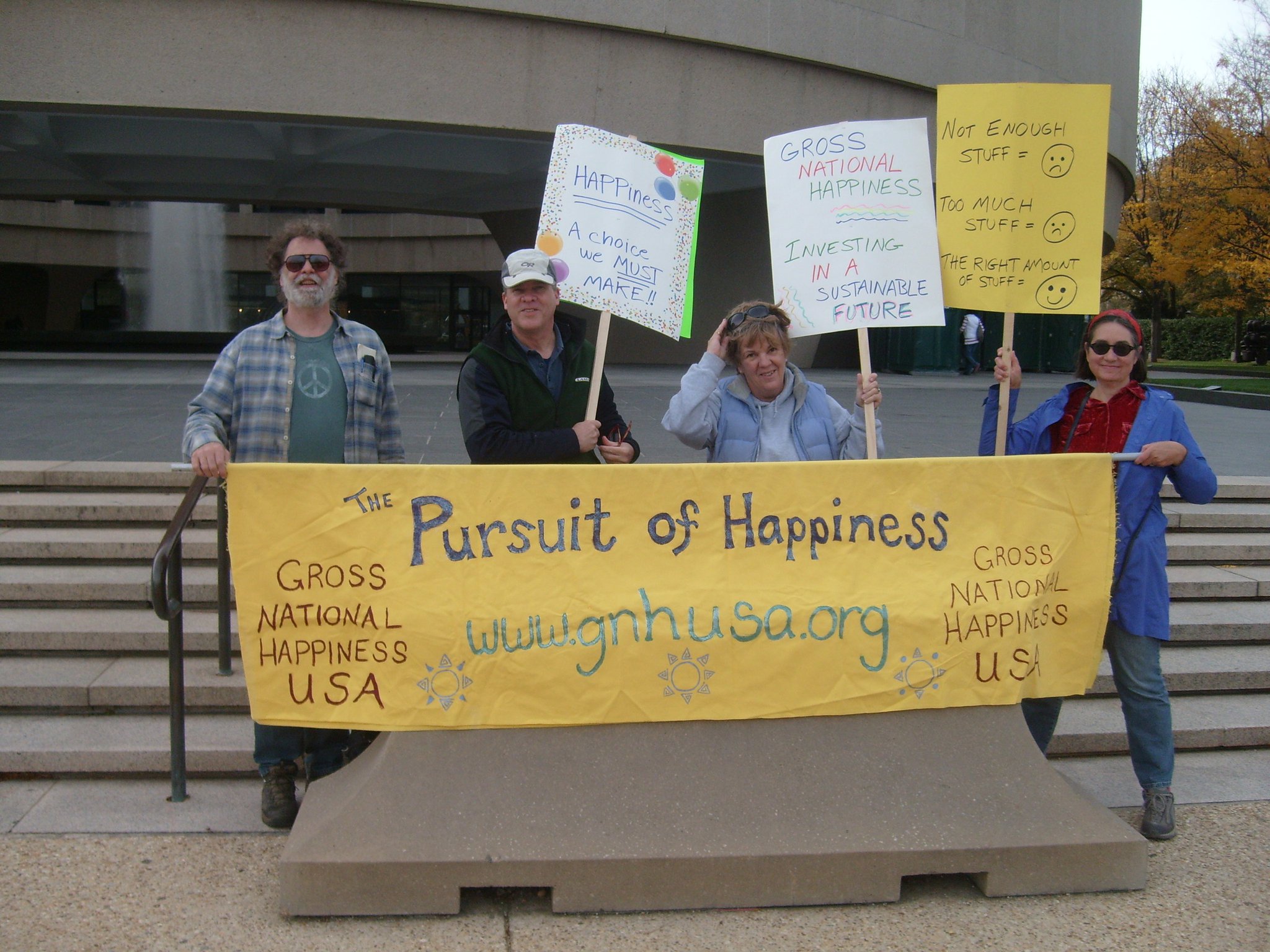
Now, with greater mindfulness, I’ve returned to work with GNHUSA again on various projects — including, in October, joining  fellow co-founders Linda Wheatley and Paula Francis for a few days on their “Pursuit of Happiness Walk”from Stowe, Vermont to Washington, D.C.   Sometimes the journey is both literal and metaphorical!

The benefit of finding and sharing our strengths was very clear on day two of the Seattle conference, when Scott Crabtree, Steve Poland, and I had the honor of co-presenting a workshop on personal happiness.  Scott — a young, polished, and engaging businessman — went first, with a high energy, professional presentation.  Next up was Steve, a deeply thoughtful psychologist and academic who brought a teacher’s care and concern to the group.  Finally, I shared my artistic (perhaps quirky?) individualized approach to spreading personal happiness.  This combination seemed to be well received by the 30 or so people in attendance.

Throughout the conference, there were many references to, and practices of, gratitude.  Indeed, those of us who are already activists in the movement are very blessed to cultivate a deep internal happiness while giving our best in service of greater well being worldwide.   We have much to be grateful for. Those of you not yet actively on board, please know that you — the real you, the authentic you — are welcome to join us in this work.  We’ll be grateful to receive your gifts.

In early July, I spent hours and hours painting 170 glittery hearts on small rocks I pick up while walking on Vermont’s dirt roads.

170 heart stones ready to hand out at the parade

I normally give heart stones to people who come to the Happiness Paradigm Store and Experience as a tangible reminder of how important generosity is to happiness.  This batch of stones was specifically painted to hand out to spectators at Montpelier‘s Fourth of July parade.  A group of friends and family joined me in a Happiness Paradigm contingent, including my husband Bob playing happy songs on the ukulele with a miscellaneous group of back-up singers.

Two children — 3 year-old Edwin and 5 year-old Avery — were the primary stone givers.  Edwin was low key in his baseball cap, but Avery was sporting an amazing face painting, a cape, a wizard hat, and bells strapped to her shoes so she made music when she ran — which she did, quite earnestly, to put the stones in welcoming hands.  Anyone fortunate enough to get a stone from either child had to have experienced a surge of happiness.

Edwin and Avery, getting ready for the parade to start.

It was a delightful and lighthearted experience — and, very, very serious.

Working in the happiness field has a multitude of rewards, but what truly motivates me is my concern for the environment — more precisely, climate change.  I am a strong believer in the urgent to need to shift our personal and societal definitions of success toward genuine well being and away from money and material goods.  The latter not only fails to take happiness into consideration but also feeds our runaway consumerism.  This, among other evils, trashes the environment to such an extent that our very survival as a species is in peril. Whereas, following the happiness path is a map toward a compassionate and sustainable future.

You may think this is hyperbole, but I don’t mean it as such.  Many brilliant, sober, knowledgeable individuals have connected the dots between our obsession with a growth economy and the destruction of the earth, our home.  For just one quick example, check out Annie Leonard and “The Story of Stuff.”  It is no accident that everything for sale at The Happiness Paradigm is re-cycled or re-purposed.

But back to the parade … our weather that evening was heavenly, an absolutely perfect summer blessing.  The same could not be said for Washington, D.C. where we lived for several decades before moving to Vermont.

The weather there was dreadful.  The unprecedented derecho that clobbered D.C. residents — along with millions of others from Chicago through West Virginia and out to the Atlantic Ocean — was enormously destructive.  At least 22 people died, and nearly 4 million customers were without electricity for nearly a week — a period of “unrelenting, stifling heat,” according to an AccuWeather.com report.

That means, many millions of folks were truly suffering.

I knew heat when I lived in D.C.  One summer weekend, when our kids were away at summer camp in Vermont, the temperature crept into the low 100’s.  My husband and I got cold salads from the grocery store and camped out in our bedroom, where we had a window air conditioning unit.  It was just too hot to be anywhere else in the house.  We did go to a movie that night, and I remember standing in line outside the theater in the early evening when it was still hot and humid enough for sweat to roll down my back.

One weekend of that in the 1980’s was kinda fun.  It’s not fun anymore — especially when you factor in the fires, floods, tornadoes, and a drought being compared to the dust bowl, all in our country in the last year.  Scary.

And scarier: read Bill McKibben’s new article in Rolling Stone magazine: “Global Warming’s Terrifying Math.”  McKibben, who strikes me as more of a straight-shooter than a fear monger, says he is almost without hope that future humans will be able to survive on this planet.

It just doesn’t get any bleaker.

Fortunately for me, I’ve also been reading Barbara Frederickson’s seminal book, Positivity.   Frederickson’s words are helping me keep my own spirits buoyed, which is absolutely a good thing.  Her years of research have proven that negativity shrinks our ability to see options.  Positivity demonstrably leads to greater resilience and increased creativity in problem solving.

Frederickson calls this broadening, and I saw this principle at work yesterday after a session of laughter yoga at the Happiness Paradigm.  We were discussing why happiness matters in light of climate change, and one participant observed that when we’re happier, we have much broader vision and greater appreciation for the beauty of the natural world around us.  Thus, we will be much more motivated to take better care of the environment.

Another giant in the positive psychology field, Martin Seligman, stresses that working from strengths makes us individually happier — and his website has a free test anyone can take to learn more about what our personal strengths are.  It also seems extraordinarily practical to know how to make our best contributions to tackle the challenges ahead.

Happier people are also more optimistic, a precious trait in tough times.  As Seligman, puts it:

“Optimism is invaluable for the meaningful life.  With a firm belief in a positive future, you can throw yourself into the service of that which is larger than you are.”

There is an awful lot right now that is larger than we are, tribulations that will severely test our resilience, and tremendous problems that will demand widespread creativity to solve.  Frederickson and Seligman both remind me of the urgency in spreading happiness.  So does this Albert Einstein quote recently making its way through social media:  “We cannot solve our problems with the same thinking we used when we created them.”

The “same thinking” has been the growth economy.  We need a new paradigm to solve the problems.  A happiness paradigm.  ASAP.

In 2005, when I was in my early 50’s and weary of the full time craft show life, I decided to study mediation at Woodbury College.  With no mediation experience or knowledge, I failed to appreciate the irony when I told Admissions Director Kathleen Moore (now a dear friend) that I hated conflict while I simultaneously professed my enthusiasm for enrolling.  Mediators, it turns out, work in the heart of conflict.  My remark convinced Kathleen that I was not going to apply.

But I did, earning an M.S. in Mediation and Applied Conflict Studies in 2007.  I loved the program and the “magic” of mediation.  Indeed, I’ve never really left.  Even before I graduated, I began working for the program — now owned by Champlain College — as a coach for new mediation students.  Several times a year, I head to campus to support fledgling mediators as they practice their new tools in emotional role play after emotional role play.  It’s an exhausting but satisfying gig, and I’m grateful for it.  I also created Home Share Now‘s position of staff mediator, and have been  a conflict coach and conflict skills workshop facilitator.

And, I still dislike conflict.  It makes me sick to my stomach, and I want to avoid it.  It’s just that now I know that avoiding conflict is rarely the best choice.  So when I’m in the midst of an upsetting situation, I grit my teeth and plunge in.  In those moments, I am decidedly unhappy.  Ugh.  I just hope that facing the hurt and anger with skill, honesty, compassion, and forgiveness — toward the other person and toward myself — will ultimately lead to greater understanding, healthier relationships, and more happiness.

Since conflict is inevitable in relationships, and strong relationships rank in the top five of almost any happiness list, learning how to engage in productive conflict is a key happiness strategy.  Poorly managed conflict can undermine or destroy relationships; conflict done well strengthens relationships.

I remember the “aha” moment when this truth struck home.

Just a couple of kids in love

It was during a break from a probing class on Interpersonal Conflict, taught by the redoubtable Tammy Lenski, author of The Conflict Zen blog.  As I recall, Tammy had just pegged me as a conflict avoider, one of five universal conflict styles*.   Headed toward the bathroom, I thought, “I do NOT avoid all conflict.  I always engage in conflict with Bob!”  And then I thought, and who, out of everyone I know, do I have the best relationship with?  Hands-down, with my husband Bob, with whom I am very happy.

Hmmm.  Coincidence?  Of course not.

Apparently, conflict actually — ultimately — makes us happy.

Still in love, 40+ years later

Of course, that’s conflict done well — and that isn’t an easy standard, even for conflict professionals.  We humans are complex,  messy, and obliviously self-serving — especially when we’re pissed off.

The good news is, no one needs a master’s degree to get a lot better working through arguments, differences of opinion, hurt, etc.  Once again, Bob is “Exhibit A” for me; he learned with and from me as I earned my degree, and his own conflict skills have improved significantly.

Over and over in my happiness research, the tremendous value of mindfulness rises to the surface.  Conflict is no exception.  You have to be mindful as you ask, what is really going on here?  What did I do?  Why?  What do I want?  Why?  Ditto for the other person. Because the answers can be painful, compassion also comes in quite handy.

One way to make it easier to answer these questions is, to use mediator jargon, figure out what each person’s positions and interests are.  Once you know what each person really wants, you’ll have a much better shot at coming up with a solution that leaves everyone at least moderately satisfied.

I’ll illustrate by sharing a situation when I was not exactly at my best.  Bob had done the grocery shopping, and, as per request, had bought me shampoo.  But it was, sin of sins, the wrong shampoo!!  I love the scent of vanilla, and through the years had told him repeatedly to please get the vanilla shampoo.  He hadn’t done so, and I got mad.  I made some ungrateful and ungracious remarks, and he got mad, too.  We retreated to our corners, both of us steaming.

Since life in my house is much happier when we are not angry at each other, and, I had this shiny new mediator degree in my back pocket, I sat in my corner and tried to figure out why we were so upset.  “You bought the wrong shampoo!” was a positional accusation.  I needed to understand why it mattered so much — then I would know what my interest was in this conflict.  I realized that I did not feel heard, or validated, by my husband.  In other words, my feelings were hurt.

I also knew my own behavior left something to be desired (as one friend put it, “my halo had slipped”).  Acknowledging our own contribution to conflict is another helpful tool in working together toward a solution.

So I went back to Bob, and asked him to please work with me on understanding what had happened.  After he reluctantly agreed, I apologized for my reaction and my hurtful words.  He knew all about positions and interests, so I told him what I thought my interests were and asked him what he thought.  He then told me that when he realized the store was out of vanilla shampoo, he had tried hard to figure out what other scent was mostly likely to please me.  He thought it was better to get the best possible shampoo, rather than no shampoo at all.  Naturally, my pissiness at seeing his choice had stung.

From that point on, we could not only work through this incident but even learn from it: I now buy all my own shampoo.  Conflict successfully resolved!

Okay, a little marital spat about incorrectly scented shampoo is of no great importance — on the surface.  But in this incident, as in most incidences, the real important concerns (interests) were below the surface (position).

Positions and interests were also on my mind this morning while I took care of my three-month-old grandbaby.  When she cries — well, that’s positional.  The reasons she cries — hey, that’s her only way of expressing her interests.  Hungry, bored, tired … When I correctly understand her interest and respond accordingly, one of the things that’s happening is a deepening of the relationship between us — and that makes me immeasurably happy.

Paradoxically, using positions and interests in conflict situations is both elegantly simple and frustratingly challenging.  In addition to mindfulness and compassion, it can take persistence, courage, hope, and lots of open-hearted questioning and listening.  You may even have to be the grown-up in the situation, which is challenging in and of itself when you feel wronged.  But hang in there.  You might just end up happier.

_____

* The other styles are competing, accommodating, compromising, and problem-solving.  I’ll discuss these and various other helpful conflict tools, in later posts.

The Tennessee Williams quote “I have always depended on the kindness of strangers” makes me smile, thanks to the brilliant satirical musical “Streetcar!” on “The Simpsonsback in the 20th century.  Marge sang the lead, with absolutely fabulous back-up singers who belted out, “You can always depend on the kindness of strangers … A stranger’s just a friend you haven’t met.  Streetcar!”

This blog, though, is sober — deadly serious, in fact.  Two days ago, the kindness of a stranger may have saved my son Ben’s life.  The stranger’s kindness has filled my family with gratitude (a key happiness tool) and has spared us from immeasurable pain.  We don’t know who he is, and he will never know how profoundly he helped Ben — but his actions illustrate how interconnected our lives are, and how our choices can impact the happiness of others.

Ben on his first birthday, 38 years ago this month. He’s still pretty cute, though.

Here’s the story:

Thanks to another gift — a very, very small inheritance check from his grandfather — Ben bought a new-to-him pick-up truck from a dealer in Vermont’s Northeast Kingdom, about an hour and a half away.  I drove him to pick up the truck.  We decided not to convoy on the return trip, as he needed to stop for gas.  Also, he observed, I had my cell phone so he could always call if for some reason he needed help.

Or not.  In this part of rural Vermont, cell coverage is highly sketchy.

Did I mention the tornado warnings?

Right before we left home, I learned from The Weather Channel that our entire area was under a tornado watch.  And as we drove north, I kept the radio on, just in case the dreaded emergency broadcast signal began.  It did, with warnings of a severe thunderstorm headed toward in the same direction as we were.

So when we left the dealership, I was eager to skedaddle south as quickly as possible — radio still on, with more warnings.  Tornadoes, this time, in the towns I had just driven through.  I quickly calculated that, even stopping for gas, Ben was probably through those towns, too.  All was well.

At home, I breathed a sigh of relief and then looked at my cell phone.  Ben had called twice.  Not good.  Not good at all.  Anxiously, I called back.

He was stressed, though alright.  He, too, had been trying to drive out of the tornado zone — but ran out of gas and was stranded along the interstate, in the bull’s eye of the oncoming storm.  Minutes before it hit, the stranger picked up my son and dropped him off at a gas station in town.

The tornado touched down nearby, taking out hundreds of trees and one chimney — but, as it turned out, that wasn’t the real danger.

When Ben finally got back to his truck hours later, it was … gone.  As in, totally destroyed.  And shoved several hundred yards farther down the highway shoulder.  During the fierce storm, another trucker had accidentally rammed into the back of Ben’s new truck, completely wrecking it.*  Without the kindness of the earlier stranger, Ben would have been in the truck at the moment of impact…

Okay, that’s all my mother’s heart can bear to write.

I’m reminded of the Dalai Lama‘s wisdom that, in every interaction with every person, we can either contribute to that person’s happiness or contribute to that person’s unhappiness.  Usually I interpret that as sharing smiles, pleasant greetings, or maybe a hug.  Not, saving someone’s life.

I’m reminded, too, of an incident many years ago when Ben may well have saved the life of another stranger.  It was a cold November evening and Ben was outside having a cigarette (that’s another story!).  From somewhere in the woods at a bit of a distance from our house, he heard — or thought he heard — a very faint cry for help.  Together with his dad, Ben took off running toward the voice, which belonged to a hunter who had fallen from a tree and broken his leg.  The hunter was alone and unprotected.  The night was about to turn freezing.  Thanks to Ben, emergency personnel got the hunter to safety.

None of us know who that man was, either.

I have on my bookshelf Exploring Happiness: From Aristotle to Brain Science, a review of morality and happiness by the very thoughtful Sissela Bok.  I have thought about the concept of morality of happiness from the viewpoint that our happiness choices might have a negative effect on others — ie, drinking non-fair trade coffee could lead to suffering and exploitation of those who pick the beans in countries far from me.

But the truck incident has turned my thinking around.  Our moral choices, decisions made from kindness or a generosity of spirit — say, picking up a driver stranded by the side of the road — could well enhance the happiness of others far beyond our knowing.

My daughter Jennifer wrote on Facebook of her gratitude to the stranger who saved her brother’s life:

“So I say: THANK YOU with all my heart to the man who potentially saved my brother’s life yesterday by being generous and giving him a ride.
And I invite you to think about what you can to with small gestures that make a world of difference.”

Indeed.  Sometimes we need a kind stranger, sometimes we’re called upon to be that kind stranger.  Happiness may depend on how, or whether, we answer that call.

* The other driver was uninjured, and Ben’s truck was insured.

Every other Sunday, services at the Unitarian Church of Montpelier include an opportunity for individuals to come forward and light candles of joy and/or concern.  I am usually shy about speaking in front of the congregation, but on the first Sunday of 2012, I was moved to  light a candle of concern for what I suspected would be a tumultuous year ahead.  I spoke of a desire to face such turmoil with a loving heart.

Spreading the happiness message at the 2010 Jon Stewart rally in D.C.

Be careful what you ask for!  I have in fact been given the opportunity to face turmoil with love: last week, much to my great surprise, my Happiness Paradigm was included as an object of derision  in an online tirade against “the happiness crusade.”

The article — “Happiness is a Global Tax” — is on the Accuracy in Media website.  When I first read it, I felt a cold sense of dread reading my own words (taken from the Online Store page of this blog) being somehow used as a weapon against me and my colleagues coast-to-coast working to advance the gross national happiness concept.

A few days later, I could laugh at the author’s connection between my happiness artwork and discussions held at the United Nations summit on “Happiness and Wellbeing: Defining a New Economic Paradigm” in early April.  Though I unfortunately had nothing to do with the U.N. meeting (I’m still on grandmother leave!), the Accuracy in Media author wrote: “And so, from tiny recycled gratitude journals do mighty international tax plans grow. …”

Seriously? Seriously!  Now that is funny.

But back to that love thing … When I had more time to reflect on the article, I knew I wanted to react with love and compassion.  I know nothing about the author, but it isn’t hard to feel compassion for her.  After all, what are the wounds and struggles that would cause someone to approach happiness with such fear?  I’ll likely never know, and even asking the question seems a tad presumptuous — but it does allow me to think of her with love, and that makes me happier than hanging on to anger, hate, or fear.

For some reason, this incident made me recall my lack of compassion during another era when I acted against a dominant paradigm.  I was in the ninth grade, a normal 14 year-old girl (read, “boy crazy”), except for my home life.   My family were liberal Democrats, and fairly open-minded on issues like race.  So when I got a romantic phone call from a black football player, I was simply thrilled (A boy!!  Calling me!!).  Race didn’t matter at all.

Little did I know that our relationship would lead to public anger and approbation in my very conservative, overwhelmingly white school because the reigning paradigm did not condone inter-racial dating.  The worst disapproval came from two of my closest friends, Debbie and Cindy, each of whom told me that her parents forbid her to have anything more to do with me.

And for that, Debbie and Cindy suffered.  We were in the same section together — that is, we shared all our classes.  For a variety of reasons, the section coalesced around me.  Debbie and Cindy became the outcasts.  I don’t remember wanting to hurt either of them, but I did want and need the support of the rest of my classmates and friends.  I’m sure I gave little thought to their pain.

Today, I think of the 14 year-old Debbie and Cindy with compassion.  And I hope to hold my more mature self to a much higher standard of love and compassion than my adolescent self was capable of.

The Accuracy in Media article also brought to mind a video I watch frequently after meditating: a beautiful and moving rendering of the St Francis of Assisi prayer by  Sarah MacLachlan.    In particular, the request in this song to “seek not so much to be understood as to understand” resonates today.

However, compassion and understanding for happiness naysayers does not mean less advocacy for the cause of shifting our individual and collective aspirations toward well being rather than materialism.  Indeed,  I was tickled when my husband emailed me this message,  “Congratulations!  You made it to stage two!”  Attached was the following quote:

“All truth passes through three stages. First, it is ridiculed. Second, it is violently opposed. Third, it is accepted as being self-evident.”Arthur Schopenhauer

Indeed, I hope the happiness paradigm will someday be accepted as self-evident.  Until then … well, here’s to understanding, love, and compassion!

Happiness is a new baby — especially when that baby is a much longed for, dearly treasured grandchild.  Meet the newest addition to our family: Madeleine Arden Sassaman, shown here at six days old.

My granddaughter Madeleine, six days old.

It’s a no brainer that new babies bring joy.  They are fresh, innocent, full of hope and potential —  the personification of pure love.  Most people respond with warmth and smiles to a baby, any baby.  That reaction is magnified a million fold when the baby is near and dear to your own heart.  Some life events cause our natural happiness levels to soar dramatically; Madeleine’s arrival is the happiest event I can even imagine.

I won’t try to over analyze this most obvious of happiness highs.  But I do want to highlight a few fundamentals of day-to-day personal happiness that my granddaughter’s  birth brought into sharp relief.

First, savoring.   Over and over in Madeleine’s first week, I watched her mother delighting in her every detail — the perfect fingers, the amazing tiny toes, her head of silken hair, soft breaths, ability to hold her head up, etc.   Jennifer just drank in every aspect of Madeleine.  “I don’t want her to ever change,” Jennifer sighed.  “She’s perfect right now.”

New babies are scrumptious — but more ordinary opportunities to savor are multitude in our daily lives.  For example, as I rocked my grand baby on the front porch this morning, I could also savor the beauty of pink balloons wafting across a leafy green and sky blue background.  Earlier, I savored the coffee that helped wake me up before going on baby duty.  I could hear birds, and my daughter’s laugh, and watch butterflies, bumblebees and wild flowers.  All this, in an ordinary neighborhood in a rural southern town.  Here, there, everywhere, we can savor away … The very thought is enough to make me smile.

Gratitude.   Jennifer went into the birth experience somewhat apprehensive of hospitals and modern medicine and determined to have a natural birth — but that was not to be.  Despite many, many hours of excruciating pain, Jennifer’s cervix did not dilate enough for the baby to come out the birth canal.  Without an epidural, my daughter’s agony would have been unspeakable.  Worse — in another time and place, when C-sections weren’t viable options, Jennifer’s situation may have led to both maternal and infant death.  Maybe I’m wrong, and maybe that’s over-dramatic — but both she and I are very grateful to Doctor Jennifer Logan and all the compassionate and skilled staff at Montgomery Baptist East Hospital for providing the care that meant a happy, healthy homecoming for mommy and baby.

This is gratitude writ large, for sure.  Also, for sure, we all have many reasons to be grateful every day.    Today, I have been grateful for things large and small — like Madeleine finally falling asleep and a well-stocked refrigerator as lunchtime drew near.  Like savoring, the opportunities for gratitude are always at hand.  We need only invest a conscious effort in acknowledging our appreciation.

Community.  While I would never want to relive my daughter’s labor, I will always treasure that night.  The community gathered around Jennifer — the baby’s dad, the doctor (on-and-off), Jennifer’s best friend and the friend’s teenage daughter, and I — shared her sacred journey.  We laughed, cheered, cried, wept, ate, slept, and waited during a period of time in which no reality existed beyond Jennifer’s efforts to give birth.  As we supported Jennifer, we also leaned on each other literally and emotionally.  We were intensely connected.

The next day, as I walked past the labor room on my way to Jennifer’s hospital room, I felt a pang of nostalgia.  There was so much love and beauty in that one-time-only community!  It was a powerful reminder of the importance of building and maintaining community connections in our “regular” lives.

Then there’s money. It is costing me a lot of lost income to be with my daughter and granddaughter for a few precious months.  I live in Vermont, my daughter lives in Alabama.  To be here, I had to close my “Happiness Paradigm Store and Experience” for two months, and turn down other income-generating opportunities. Plus, the trip here and back — by car, and staying with friends — is pretty pricey.

I am not entirely sure how I’ll pay my bills over the next few months, but there was really no question about what I should do.  How could I have possibly chosen money over the opportunity to be with my daughter before, during, and after she gave birth?

This is a particularly valuable lesson for me personally.  I constantly struggle between the desire to move away from the demanding paradigm of making more money, and the desire to actually make more money.  Perhaps my choice this spring will help me find greater comfort and balance around money questions in the future.

One last observation: caring for a newborn and the newborn’s mother is hard work — so much so that I haven’t found time to invest in my specific happiness strategies since Madeleine was born.  I haven’t meditated, done yoga, sung in the choir, written in my nightly positive journal, or painted a gratitude watercolor in weeks.  I miss those practices, but Madeleine has lusty lungs and will not be ignored.  Soon enough I’ll go back to Vermont, where I will no doubt pine for the hours of rocking this infant to sleep. I love her.  That love fills me with more than enough happiness for now.

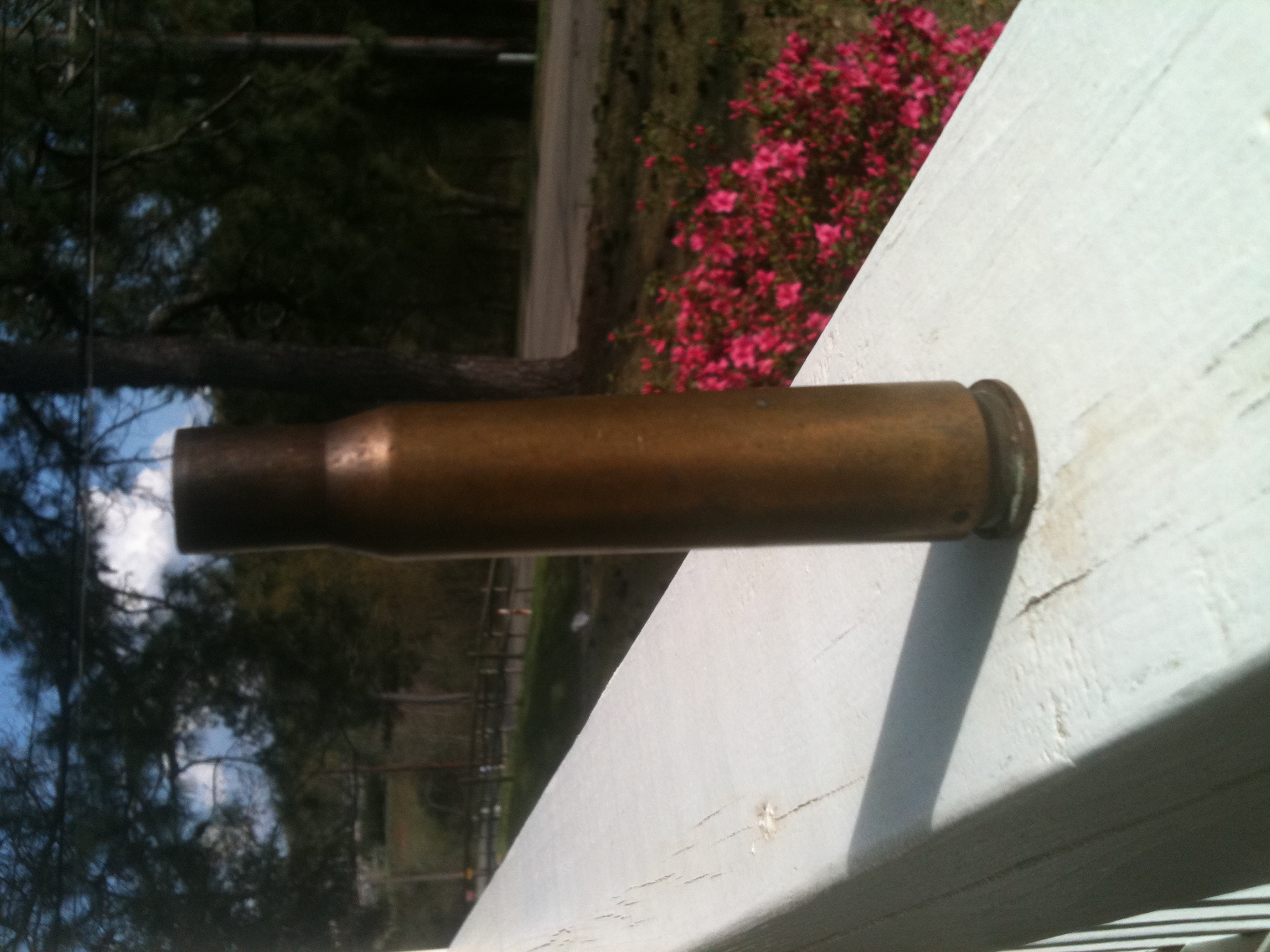
The shell casing I was given at a garage in rural SW Virginia.

Last Wednesday got off to an easy, breezy start.   Then, as life is wont to do, the day took a more challenging turn.

Here’s the cool thing: the worst, highly  stressful, and most expensive part of my day grew into a sweet,  surprising and profound life episode.  It was an unlikely lesson in happiness.

This blog is a little long, almost a short story.  I’d love to know your reaction.  Here goes:

The weather was fabulous.  I was feeling fine, cruising along life’s metaphorical highway, and the very real real I-81 — an overcrowded interstate with the benefit of spectacular mountain scenery on both sides of the road.  Savoring is a highly effective happiness strategy, and I was savoring the view big time.

While I drove, I listened to The How of Happiness: A Scientific Approach To Getting the Life You Want by Sonja Lyubomirsky.  Though I was familiar with many of the book’s concepts, much of it was new and exciting.  Learning makes us happy, and I was in the learning flow.  Quite happily.

I was also happily driving toward my daughter’s house, to help her in the weeks before and after she gives birth to her first baby and my first granddaughter.  Helping others — again, an excellent happiness strategy.  Building connections with loved ones — bingo, lots of happiness there.

But that’s not all.  Before I got to Alabama for the birth, I’d be stopping in the western highlands of North Carolina to stay with my friend of 40+ years, Jeannette Cabanis-Brewin.  Jeannette had arranged to host my first ever “Happiness As A Way of Being” 3-hour workshop — so I had a clear purpose to aim toward.  Guess what?  Having a purpose is happiness inducing.

I picnicked at a roadside rest, where I could pat myself on the back for savoring the wildflowers, the clouds, and the butterflies, and being grateful for my husband for packing my food and for the custodial staff who kept the rest area clean and beautiful.  Uh-huh, I was doing just fine in the happiness department.

And then …  happiness became harder to access.

I had stopped for gas in a tiny town, far in the southwest corner of Virginia.  I misjudged my turn into the gas station driveway, and ran over the curb.  The sounds from my car’s underbelly were ominous.

Nonetheless, I paid for and pumped the gas.  I was eager to get out of there.  Not only was I worried about reaching my rural destination in the daylight, I felt like an unwanted alien in this part of the world.  In our red state-blue state country, I felt like my Vermont license plate was a bull’s eye.

So I gave the car a once over, saw nothing amiss, and started up the ramp toward the interstate.  The next sounds were unmistakably bad; I had busted up the front right tire pretty impressively, even cracking the hub cap.  I backed down the ramp — something my righteous self always judges others harshly for doing — and returned to the gas station.

Happiness?  What happiness?  Fears and anxieties were coming on strong.  I am not good with things.  I generally operate on the assumption that they will always work.  When they stop working, usually my husband (who can fix most anything) takes care of it. Now, I was alone.  I was going to be late.  This would probably cost a lot of money.  I was stuck for at least a little while in an uncomfortable environment.

Fortunately,  my happiness studies have taught me that one reason to continually strengthen the brain’s ability to access happiness is to be able to bounce back when your life gets derailed.  Obviously, in the scheme of things, a busted tire is minor, just a baby blip.  Still, I was upset and aggravated.  And, I had an excellent opportunity to walk my happiness talk.

First up: dropping the internal wall I had built between myself and the folks who lived here, folks whose help I now needed.  I struggled to put my own prejudices aside, and reach out, person-to-person.

After a few phone calls, my angel arrived in the form of a young man named Jake.  Jake drove a black Camaro and had such a thick mountain accent that I couldn’t always decipher his words.   Nonetheless, he made clear from the get go that he was there to help me.  He was unfailingly polite, kind, and non-judgmental — even when I couldn’t tell him where the jack was located in my car.  I felt like an idiot, but a grateful idiot.

Jake eventually got my car to the garage where he and his father work.  He urged me to come in out of the hot sun.  When their garage didn’t have the right sized tire, Jake took off for the local junkyard, and got into an argument with the owner who was trying to close for the day.  Jake insisted that the junkyard stay open long enough for him to find the tire that I needed.

Meanwhile, Jake’s daddy came over to talk to me.  “You are a very lucky person,” he said.  His words threw me for a loop.  They felt like a message from the Universe.  “I believe I am,” I replied.  “But why are you telling me that now?”

He replied, “Because you got my son to help you.  Most people these days, they won’t help.  But he’s a good boy.  He’s made an enemy of the junkyard owner, all to help you.”

I decided to tell the dad about my happiness workshop.  He told me, “You want to be happy?  Find God.”  My defenses wanted to rise up, but I managed to beat them back and keep listening.  “I was never a godly man before,” he said.  “But a few weeks ago, a lady came in here and we test drove her car to see what was wrong. ‘There’s nothing wrong with my car,’ she said. ‘God is trying to get your attention.  There’s going to be a tornado, and it will hit you at this spot in the road.'”  A few weeks later, as killer tornadoes struck throughout the South and Midwest, the dad and his truck were indeed lifted up and thrown down by a tornado in the exact spot that woman had predicted.  The truck was totaled.  Three people in town were killed.  He believes in God now.

I was amazed at the story, and at his decision to share with me.

He continued working while we waited for his son to return with the junkyard tire.  After a bit, he asked for a favor.  He pointed out his boss, the garage owner.  “If you do nothing else today, tell him what a good job my son is doing for you.”  Of course, I said I would.

So I struck up a conversation with the boss.  Turns out, he’s a granddad of three, happy to wish me well on my journey.  After I told the boss how grateful I was for Jake and his dad, I came out and exchanged conspiratorial nods with the dad.  Those nods gave me a surge of joy.  We were connected.

All the while, I kept beating back fear and anxiety.  How much time was this taking?  How much money would it cost? How far was I from Jeannette’s house?  When would it get dark?  Would I be too tired to drive?  Would I have more car troubles?

Concurrently, I practiced happiness strategies — gratitude, connection, and a reminder that I was actually perfectly okay in the moment.  The strategies kept me calm, and aware of the good in my situation.

In preparation for the happiness workshop, I had with me a bin of gifts I like to hand out: common stones on which I’ve hand-painted glittery hearts.  To me, they symbolize giving from the heart — and I gave one to Jake when I paid the unexpectedly low bill.  I explained that the stone was a token of my appreciation for how well he treated me.  Jake seemed pleased.

His daddy, too.  The dad quickly said, “I have something for you!” and then handed me the shell casing in the photo.  He was glowing with pride and joy as he gave me this precious offering.

A shell casing?  Me?  I didn’t even know really what it was.  Part of my brain — the judging part, the part that puts distance between me and others — was ready to spring into action and say, are you kidding?  No thanks, buddy.

Instead I said, and meant, from the bottom of my heart, thank you.

Thank you.

Just before I got in my car, he gave me another present.  “Watch your speed!” he admonished.  “The next county is full of cops.  They’ll pull you over if you’re even five miles over the speed limit.”

And so my journey continued.  The exuberance from the earlier part of the day was gone, but a deep sense of wonderment and awe and spiritual connection had taken its place.  I was tired and still stressed, but in some ways happier.

So what’s the lesson?  For me, it’s knowing that happiness takes many unexpected forms, if only we can quiet our reptile brains and open our hearts wide enough to receive the bounty.  That sweet and peculiar sequence of events was also a gritty affirmation of my intellectual belief that we’re all connected — a belief I don’t always nurture in real life — and that happiness grows in those connections.  I don’t necessarily have to understand it.  I can just feel it.  Finally, as I wrote about in November 2011, happiness doesn’t lie merely in giving.  We must also receive, with humility and gratitude.

Postscript:The next day, I wrapped up the happiness workshop with a seven-minute Loving Kindness Meditation.  After I explained how the meditation would work, I realized my chime was in a different part of the house.  But a water glass, and the shell casing, were sitting nearby.  Thanks to Jeannette’s suggestion, I began and ended the meditation by clicking the shell casing three times against the water glass.

Perfect.

I am a lucky person.

In a few days, I will leave home for nearly two months to support my daughter during the final weeks of her pregnancy, in the delivery room, and for the first month or so of my granddaughter’s life.  I am excited and busy.  My mind is swimming with details.

Last night, though, I put details aside to be with a group of friends who held a Grandmother Baby Shower/Blessings On Your New Adventure/Please Return Safely ceremony for me.  It was one of the happiest nights of my life.

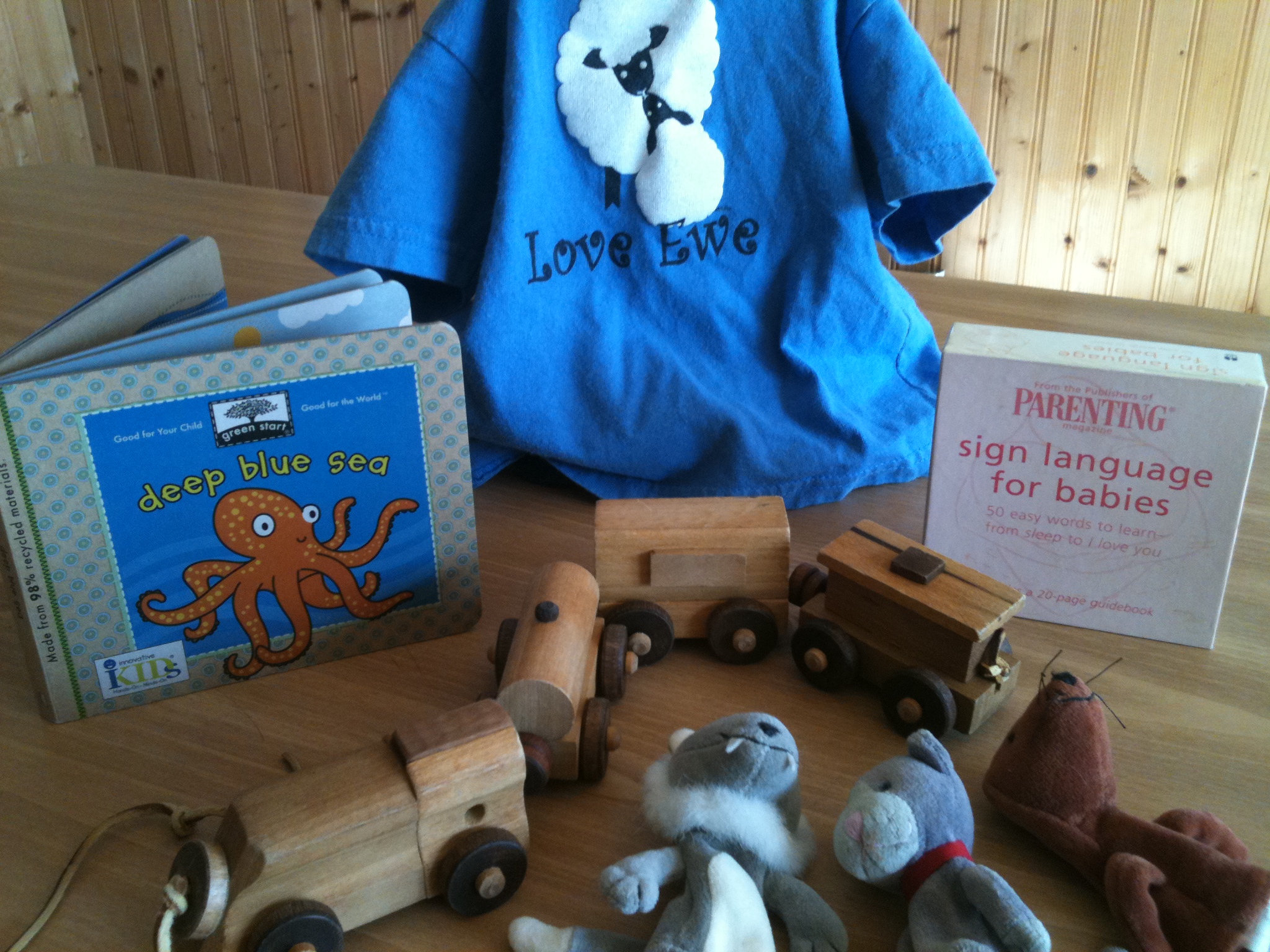
Previously Loved Baby Presents

Happiness studies show that we each have a natural happiness level, which can be raised by developing happiness habits.  Joyous events and circumstances, like the communal love I felt last night, raise our happiness level for a while. Sad, tragic, and dreary situations lower our happiness. In either case, we eventually settle back into our natural level.

This morning, I’m tired (I was too wired up to sleep well!) but still enjoying a happiness upswing.

Why so happy?  Silly question, right?  Anybody could look at the circumstances and say, of course you’re happy!  You’re about to become a grandmother, your friends just celebrated your joy — and, icing on the cake, you’ll be driving away from the tedious end of a Vermont winter into sunny warm weather in Alabama.  Who wouldn’t be happy?

Even so, I want to break it down a bit.  Grand-babies don’t come along every day, but the other ingredients of my current happiness high are available to each of us on a pretty regular basis.

Gratitude. Gratitude is one of the most reliable contributors to personal happiness, and my gratitude cup is overflowing.  Hugs, blessings, good food, thoughtful presents … I’m so, so grateful.  I’m not very good at writing thank you notes, but I’m going to send a heartfelt thank you to send one to everyone who made last night special.

Community. My town has pot lucks, talent shows, silent auctions.  We take meals to people who are sick, and check on pets.  We sing together, swim together, skate together, snow shoe together.  It’s like a bank: we make regular deposits in our community account.  And when we need a withdrawal, the “funds” are there.  It’s a solid investment strategy.

Forgiveness. When I looked around the room, I felt such pleasure in my relationship with each woman in the group. Because we’re human, I’ve been in conflict with some of the women in the past — conflict that we worked through together so we could move on.  I’ve forgiven, been forgiven, and deepened relationships.

Touch. Twice we stood in a circle holding hands.  Hugs were also abundant.  Gretchen Rubin, author of the blog and book The Happiness Project, cited research on hugging from  The How of Happiness by Sonja Lyubomirsky.  Rubin wrote about Lyubomirksy’s “study in which students were assigned to two groups. One group was the control; one group was assigned to give or receive at least five hugs each day for a month – a front-to-front, non-sexual hug, with both arms of both participants involved, and with the aim of hugging as many different people as possible. The huggers were happier.”  Let’s hear it for hugs!

Mindfulness. Savoring, and being fully present, are excellent happiness tools!  Perhaps I’ve been sharpening those tools lately through a ramped up meditation practice.  And/or, perhaps the loving energy and shining eyes all around the room were too powerful for my mind to wander, despite my pre-trip to do list.  I knew I was experiencing a very special, once-in-a-lifetime event.  I was definitely present, and in full savoring mode.

Recycling.  My friends know, I strongly believe changing our shopping habits to be less voracious consumers of Planet Earth is a requirement of our long term personal happiness.  So I was thrilled that several of the presents were items previously-loved by other babies.  I was especially pleased to know that my young friend Edwin (just three years old) gave the thumbs up to passing on one of his old trains to the new baby. Learning to give is good for Edwin’s happiness, too.

Acknowledgement.  Maslow’s Hierarchy of Needs includes the need for recognition from others (as well as internal self-eteem). In general, I try to give generously of my time, and my heart, with no expectation of any recognition (except from my faithful husband; his support is usually enough).  But I just flushed with pleasure last night when one friend explained that they wanted to have this party for me because I “do so much for the community” and I “will be missed.”  It makes me feel good even now to type those words!  Sometimes, recognition does matter.

Okay, enough analyzing.  I’ll get out of my head, and slide back into enjoying the moment.


Food.  One can’t very well have an integrated approach to happiness without considering what we put in our bodies.

It’s a big topic.  There’s a lot to ponder.

Yet it wasn’t on my mind until this week when my friend and fellow choir member Dave Grundy gave me a copy of  Prevention magazine’s  “Happiness Diet.”

I was a tad skeptical at first, but the article makes a science-based case for why certain foods and drinks enhance our mental and emotional well being.  A brief excerpt:

“Food is directly linked to three areas of brain function that create your ‘happiness ability.’  The first is your capacity to focus, think, plan and remember (we call them ‘foods for thought’).  The second is emotional regulation (‘foods for good mood’).  And third are foods that give you the ability to power through a deadline and control anxiety (‘foods for energy’).”

I’m particularly pleased to note that some of my favorites — coffee, blue or red skinned potatoes, tomatoes, and garlic — all made the list!

So what we eat affects how happy we feel — simultaneously, how happy we feel affects what we eat. Three days after Dave brought the happiness diet to my attention, the Happiness Initiative posted a link to a happiness weight loss video from an annual conference in Australia.  The sound quality of this video is challenging, but if you can hang in there, Professor Tim Sharp — Chief Happiness Officer of the Happiness Institute in Sydney — explains how to use the “primacy of positivity to achieve a healthier weight.”  Makes sense.

An integrated happiness approach also means making the connection between how our eating choices affect the rest of the planet.   For me, that means choosing vegetarian options roughly 95% of the time to help  stem climate change.

There are many, many other issues — from fair trade coffee to the rights of immigrants on our dairy farms.  I want to highlight just one wonderful way to eat fresh, organic, and local — very local — even in the depths of winter.  Thanks to Peter Burke and his workshops at the Hunger Mountain Coop in Montpelier, my husband Bob now grows a variety of nutritious and tasty sprouts all winter long.  I love watching this little garden grow on the window sill, with snow and ice on the other side of the glass.  What a treasure!

Who we eat with can also build our happiness levels.  When I worked at Home Share Now as staff mediator, I grew to appreciate how lonely it can be to eat alone, and what a relief it was for folks in a new home share match to once again have someone with whom to share meals.  Food is a connector, dining is a relationship builder.

Food also provides an opportunity for a sustained gratitude practice.  Years ago, Bob and I began lighting candles at dinner every night, even in the summer when it doesn’t get dark till 10 PM.  At each dinner, we toast someone or something — an idea, the weather, happy news, a person in pain …  We didn’t consciously establish this ritual, much less set out to do a nightly gratitude practice.  But that’s how it’s evolved.

Now, when I think about our winter toasts next to the wood stove, or the summer toasts on our screened porch, and the smiles or sadness we share as our glasses touch, and the simple food we’re about to enjoy (almost always with his home grown garlic), it fills me with contentment, joy,  and gratitude.  In other words, happiness.

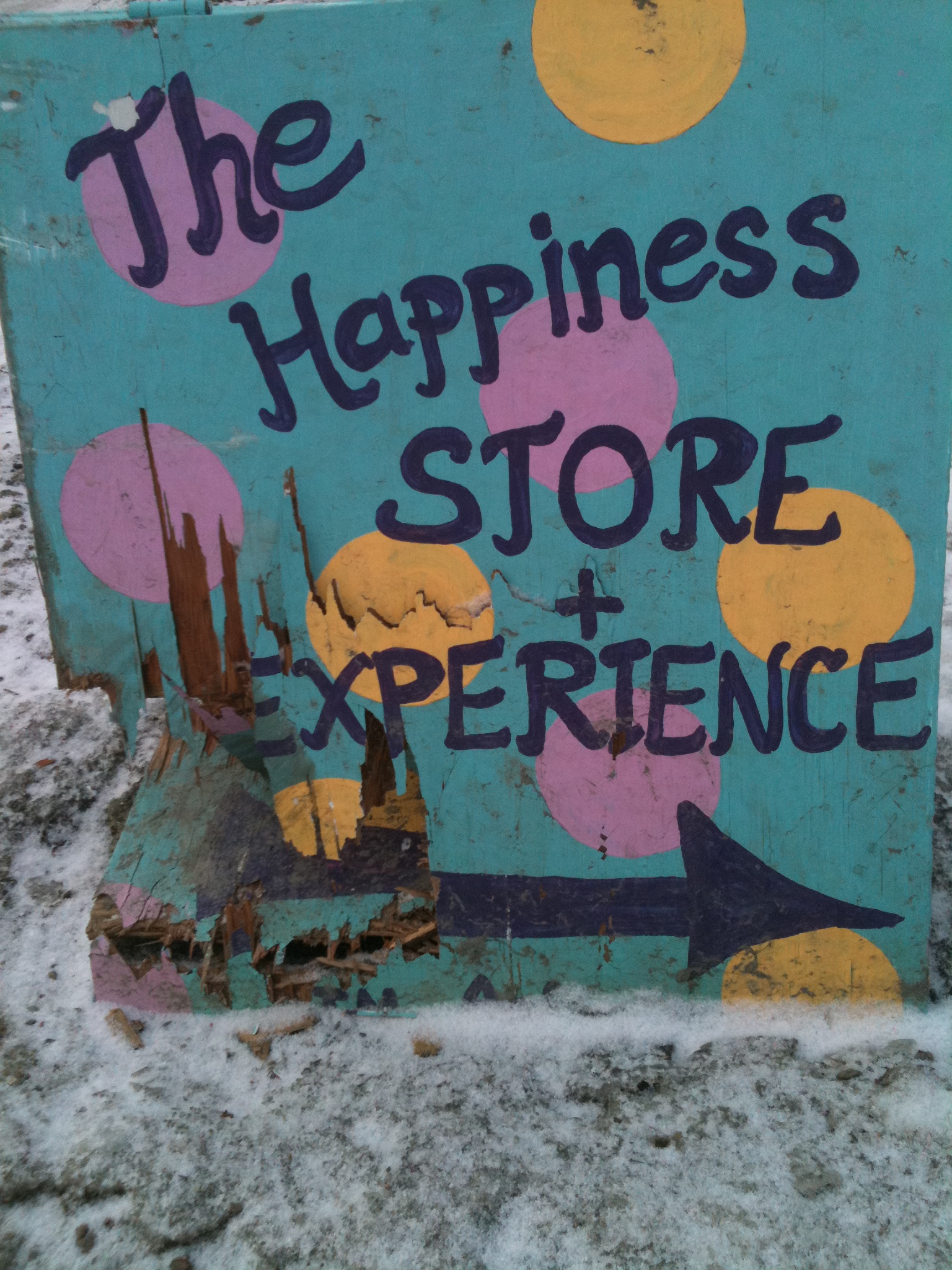
Last week, my Happiness Paradigm sign was the victim of a hit-and-run accident.  Hardly a tragedy.  Still, my internal demons flared up in sadness that my handiwork was destroyed; anger at the person who did this; and resentment that I had to make a new sign.  As you can see, the carnage was not inviting.

My not-so-happy sign, after a hit-and-run

Where is happiness in this situation?

First, in mindfulness.   Thanks in part to my mediation training, I could analyze my role in what happened (putting the sign too close to the road, for example).  I find it easier to  acknowledge one’s own responsibility, rather than simply blaming the other.  This was also a good opportunity for self-reflection — why did those particular emotions flare up?? — and therefore, personal growth.

Second, in gratitude.  My son Ben is a gifted carpenter.  He quickly and efficiently measured, cut, and primed a (recycled) piece of wood for me to use — making the new sign task much less onerous.  I am thankful for his help.

Third, compassion.  After focusing a loving kindness mediation on the person who did this,  I realized that he/she might not even know it happened.  In any case, I was able to let the anger slip away — and happy to see it go!  BTW, if you’d like to try for yourself, there are many examples of Loving Kindness Meditation on YouTube.

Fourth, the episode illustrated how expectations can breed unhappiness.  It brought to mind the first presentation I attended on Gross National Happiness and Ecological Economics.   Writer/professor Eric Zencey impressed me with his discussion of “entropy” — the inevitable and steady deterioration of a system or society.  Of course, my sign “deteriorated” rapidly!  Still, happiness lies in letting go of any expectation that things will stay as they are.

However, expectations do have a positive role to play in happiness.  The same day my sign got trashed, I reserved a lake front cabin in Maine for vacation.  Planning the trip and looking at online photos gave me an appreciable happiness boost.  According to a February 18 2010 article by Tara Parker-Pope in The New York Times, this is no surprise.  She shared research which found that we get the most vacation happiness in advance, planning and anticipating the trip.

Lead author, Jeroen Nawijn, tourism research lecturer at Breda University of Applied Sciences in the Netherlands, said, “People who are anticipating holiday trips show signs of increased happiness, and afterward there is hardly an effect.”

Still, like the sign, vacations don’t necessarily go as anticipated.  The trick seems to be, anticipating the pleasure and dropping the burden of expectations when things go awry.

So … signs … vacations … why does it matter?

In 2007, when I was researching my graduate school Capstone on mediation and suffering, Polly Young-Eisendrath, author of The Gifts of Suffering, told me that we need to practice our suffering “skills” on the little things to be better equipped to handle the large grief and suffering life holds in store for all of us.

The same is true for happiness.  Indeed, it is largely the same skill set.  I aspire to create the compassion, awareness, a mindfulness, and ability to hold onto inner tranquility during the toughest of times.  Similarly, building my happiness skills around small events may allow me to be even happier when a big one rolls around — in, oh, about a month from today!

My daughter Jennifer and granddaughter Madeleine

That’s when my beautiful daughter is due to give birth to her baby girl.  I am overflowing with expectations of joy.  I imagine the birth, cuddling and kissing the baby, reading and singing to her, rocking her to sleep, etc.  I mean, think of the toes, and the new baby smell!  Aaaahhhh …. I am in full anticipatory mode!

Other grandparents tell me that another pleasure — one they didn’t expect — is watching their children parent.  Now I think of that, too.  I fully expect to love watching my daughter be an absolutely tremendous mom.  I expect the baby’s daddy to be sweet and loving, a joy to behold.

I realize that the reality will not be — cannot be — as I envision.  Ironically, I expect the reality to exceed my expectations!  Additionally, there will be rough patches and disappointments.  That’s okay.

If something dreadful happens, the grief will be immeasurable.  I can hardly bear to type these words, but I don’t think genuine happiness can be built on denial.  Part of me is mindful of life’s tragedies — and, I see no reason to spend any real time there.

For now, the expectations are sweet.  I intend to savor them.