Genuine well being for ourselves and the planet

The face of happiness was not in the mirror on Wednesday.

A cold, which I thought I defeated, came bounding back, both the cause and beneficiary of many hours of lost sleep.  Because Tuesday saw some exciting developments in my happiness work, my mind was also very busy that night, leaping from idea to idea rather than settling into slumber.

Oh, yeah, and then there was that cup of coffee … espresso … sometime around 3:00 in the afternoon.  I wanted that latte, so I convinced myself that this time the caffeine wouldn’t keep me awake …

All in all, Wednesday was not a good morning.

Which brings me to the topic of integrating our happiness efforts — body, mind, and spirit are all involved in this endeavor.  Wednesday was an effective reminder that an unhappy body is a big hurdle for mind and spirit to overcome in their quest for a happy day.

Kerry and Ross demonstrating the fine art of integrated happiness

Kerry and Ross demonstrating the fine art of integrated happiness

I was also reminded of an Aspen Ideas Festival video I watched last week, a fascinating discussion on the neuroscience of happiness (http://www.aifestival.org/session/new-neuroscience-happiness).  Kent Berridge, a neuroscientist who focuses on the brain’s pleasure centers, asked, what’s the difference between wanting and liking?

I know I wanted that latte, and liked it in the moment — but I didn’t like it much the next day!  Perhaps a note to my brain might help avoid future replays?  “Dear Pleasure Center, please remember, no lattes in the afternoon.  Thanks for your cooperation!”

Speaking of brains (you can interpret that on multiple levels), Martin Seligman was on another Aspen panel, focused on increasing individual happiness levels (http://www.aifestival.org/session/improving-happiness-through-personal-practice).   Seligman, one of the most prominent positive psychology researchers, shared four different practices to encourage a happier brain.  I’ve started one of these practices; each night before going to bed, I write down three good things from my day and my role in making them happen.  The idea is to cultivate optimism.  My friend Liz Snell told me she’s been doing something similar for years — she calls it the TADA! list.  Now it’s my TADA! list, too.

On the panel with Seligman was Matthieu Picard, who some happiness experts consider the happiest man on earth.  Picard definitely radiated well being, compassion, and joy in his presentation on spiritual practices to build happiness.  His focus was on a dedicated, consistent compassionate meditation practice to build deep reserves of internal happiness.  “It’s like watering a plant,” Picard observed.  To paraphrase, he said, you have to give the plant small doses of water regularly.  You can’t just pour large amounts of water on the plant once in a while and expect it to live.

I’m begun practicing a loving kindness meditation daily.   I expect to write some time later about how my attempts at building happiness are working.

Wait there’s more …  We also need to integrate our happiness with the world around us.  This could perhaps be the toughest nut of all to crack.  That latte … was it fair trade?  Probably, in this case, yes — but how often are our seemingly simple pleasures bought at someone else’s expense?  It is a given for me that my pursuit of happiness should not lead to unhappiness for others, but I guess a) that’s a lot easier said than done and b) not everyone gives a hoot.

My eyes were opened to the morality of happiness thanks to yet another Aspen presenter, moral philosopher Sissela Bok (http://www.aifestival.org/session/new-history-happiness). I was so intrigued, I got a copy of her book Exploring Happiness: From Aristotle to Brain Science to dig a little deeper.

So, we need to integrate our mind, body, and spirit in the pursuit of happiness.  And, we need to integrate our personal pursuits with those around us, near and far — because, really, how could we possibly experience enduring happiness in isolation?

Last Wednesday, when I felt so sick, I walked the 100 yards from my house to the general store, which was out of chicken noodle soup!  My neighbor Kathleen Landry was at the store at the same time and saw my distress.  She brought me a can of soup from her house — one of those simple yet profound actions that no doubt gave us each a happiness boost.

Writ large and small, we’re all in this together — all our body parts, and all of us bodies.
That is, if the check is made out to the State of Vermont.

This is the time of year when I have the mixed blessing of adding up how many sales I’ve had the previous year — Sass Wearable Watercolor sales since 1991, and now, Happiness Paradigm sales.  My left brain appreciates having a concrete measure of how much my art and the other happiness products in my store grossed in sales.  I like seeing the numbers increase — except for the knowledge that as those numbers go up, so too does my obligation to remit an ever larger sales tax check to the State of Vermont.

Working on this task, I suddenly remembered the stunning devastation of Tropical Storm Irene in August 2011.  Vermonters statewide pulled together in an amazingly cohesive recovery effort — including the state itself which did remarkable work rebuilding the more than 1,000 badly damaged roads in our tiny state.

That made me think about how much I love this state.  I am so happy to be a Vermonter.  In part, I love this state because it makes me happy.  So writing a sales tax check is really a gift from my heart.

Why does living here make me happy?  There are many reasons, including the state’s tradition of progressive politics (Vermont was the first state to outlaw slavery) and how supportive the state is for artists of all stripes. The stunningly beautiful and user-friendly environment means lots of time exercising outside — hiking, swimming, snow-shoeing, kayaking.  The number one reason, though, has to be community.

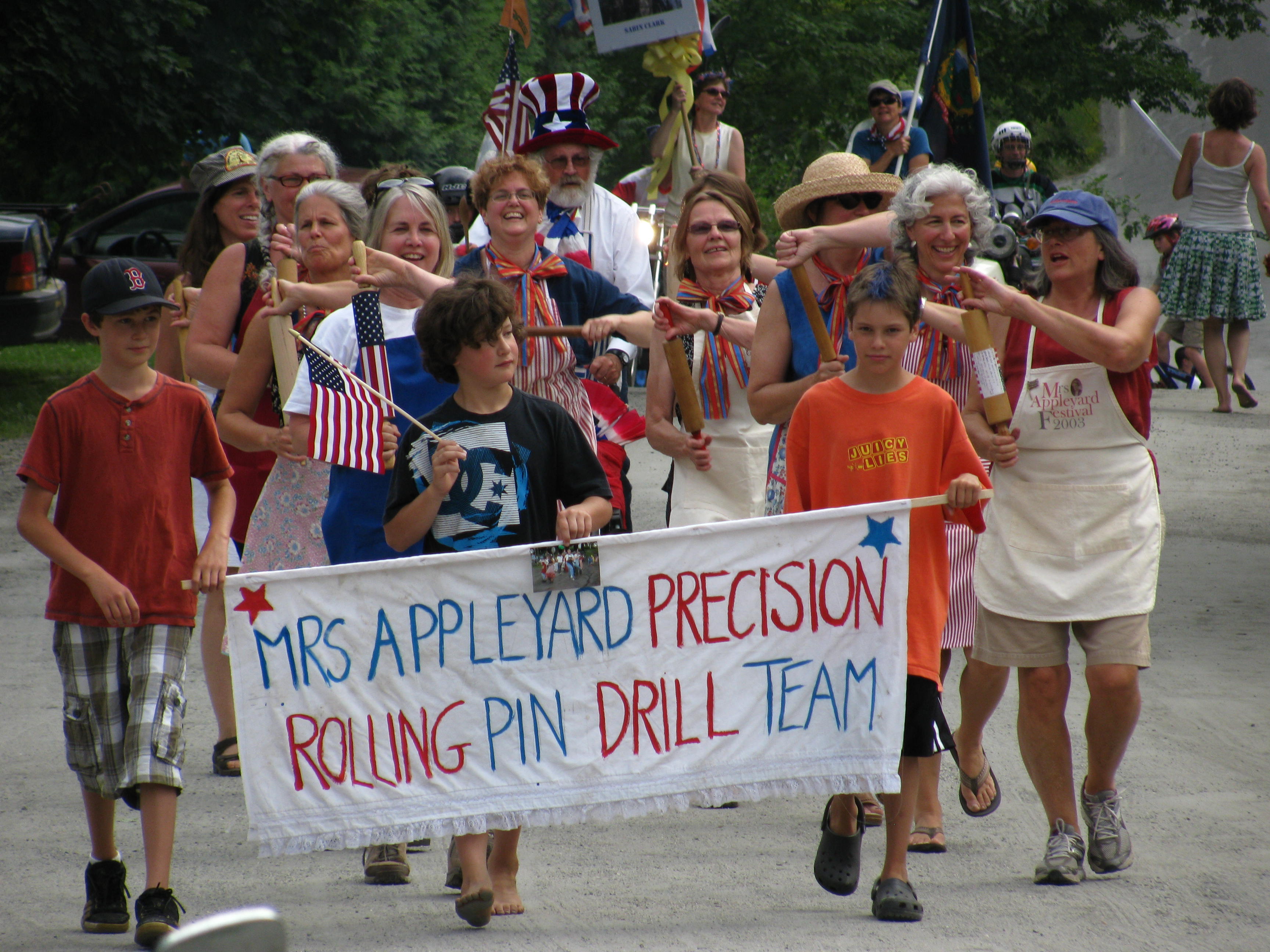
The precision rolling pin drill team in the Maple Corner 4th of July parade

Marching precisely, with rolling pin, in the Maple Corner 4th of July parade

My husband and I moved to Maple Corner in June 2001 based largely on the impression that this tiny hamlet has an exceptionally strong sense of community — and we haven’t been disappointed.  There is almost too much going on here!  We share a lot of laughs and a lot of food — which means we’re also well equipped to share a lot of tears.  When natural disasters,  illness, death, catastrophic fires, or even an ice skating accident occur here, the community swings into action with food, hugs, and whatever else is needed. When trouble knocks on my door, I will not be alone.

Of course, we do our part, too — which leads to further happiness, because it’s more giving from the heart.  We regularly march in parades, organize the local meditation group, substitute for the yoga teacher, and willingly get on stage for the annual Fall Foliage Variety Show, including this memorable turn as a turkey singing Gloria Gaynor: http://www.youtube.com/watch?v=pycBonUO_4k

It is no accident that our community, and many, many others in the state, are strong.   These days, people choose to move here because they want to invest the energy and the elbow grease into maintaining community.  We’ve become a self-fulfilling prophecy.

How did such communities evolve in the first place?  I’ve often wondered if our harsh winters were a factor.  Eric Weiner, author of Geography of Bliss, pointed out in his presentation at the Aspen Festival of Ideas that cold countries are much more likely than tropical paradises to be among the happiest countries in the world.  http://www.aifestival.org/session/geography-happiness

Two days ago, I started reading Happiness: What Studies on Twins Show Us About Nature, Nurture, and the Happiness Set Point, a 1999 book by evolutionary psychologist Dr. David Lykken.  Lykken notes that “survival became increasingly complex for our ancestors” as they “migrated away from the tropical savannas into colder climates.”  Thus, “the practical wisdom and mutual assistance of the group became increasingly important.”   Belonging to such a group required “adaptive” behaviors, including, “surprisingly, an innate tendency to look on the bright side and to be happy.” (p. 14)  Well how ’bout that?!  Sounds good to me!

Whether or not being a member of the Vermont community is currently  adaptive from an evolutionary standpoint, I know that giving to my neighbors and giving to my state fills me with a sense of purpose.  I am so pleased to be part of something bigger than myself — to be, rather, part of my state.   I’m not in the habit of quoting Roman philosophers, but I like this observation from Seneca:  “No one can live happily who has regard to himself alone and transforms everything into a question of his own utility; you must live for your neighbour, if you would live for yourself.”

One final observation on my happiness in Vermont: I am deeply grateful for the opportunity to live here.  That gratitude itself increases my happiness — a little cherry on top.

“What makes YOU happy?” That’s the question I have on a chalkboard by the entrance to The Happiness Paradigm.  Everyone who stops by is invited to write their own answers.  I occasionally step outside and add something myself.  I confess, I was the one who wrote “Bruce Springsteen,” after listening to his totally happy version of Santa Claus Is Coming to Town.

The “What Makes You Happy” Chalkboard

I also lead “Happiness Circles,” where we discuss the same question.  Naturally, in that context, the answers are more nuanced and less light-hearted.  No matter the forum, “family,” “friends,” and “pets” crop up frequently.  (See the “What Makes You Happy” page on this website for a complete list).  Such answers resonate with me.

Some answers, though, give me pause —  “style,” “video games,” and “money” — because they don’t fit neatly into my view of happiness as influenced by Positive Psychology and Gross National Happiness research.  Obviously, happiness at the individual level is  universal, unique, and complex!

I suspect the same is true at the state level; many answers I’ve collected have a Vermont-specific focus.  A lot of people here answer “snow” — a choice that probably wouldn’t show up at all in most southern states.

This universality/uniqueness balancing act no doubt applies even at the national level.   Bhutan, the first country to put theoretical GNH concepts to work, has conducted a great deal of detailed research, for which the rest of the world should be grateful.  Researchers there developed a measurement system of 72 indicators within nine pillars of happiness: psychological well being, standard of living, time use, good governance, health, education, community vitality, and cultural diversity and resilience. http://www.grossnationalhappiness.com/ These pillars and indicators are an amazing foundation for other governments to build on.   But are all the Bhutanese findings appropriate to policy making in the U.S.?  In Vermont?  In Seattle?  We need to do our own homework.

And when we do our homework — for personal, political and/or professional reasons — we need to investigate a variety of sources and schools of thought.  A recent blog from the Seattle-based Happiness Initiative, happycounts.blogspot.com, illustrated this point with an essay on the restrictive nature of Positive Psychology formulas.

Interesting.  I find that Positive Psychology theories do, for the most part, encompass responses on my chalkboard.  The Positive Psychology categories are BIG, certainly, while individual perspectives are more textured and colorful.  But they still seem to fit.  Chocolate, red wine, Bruce Springsteen and toes in the sand all relate to savoring.  Pets, cousins, and friends? Connections.  Singing in the choir — a very happy experience for me — fits in multiple categories: giving to others, being in the creative flow, lifelong learning, building community, nurturing spirituality, and even, a little bit, being physically active.

Where Positive Psychology falls short for me is its lack of emphasis on the environment.  In November 2010, I attended an otherwise wonderful seminar on happiness from a psychological viewpoint, but there was NO connection with the planet.  Yet many people tell me what makes them happy is weather related, especially sunshine and snow.  Or nature related, like walking in the woods.  With Climate Change, the importance of environmental factors is bound to increase.  I imagine folks living in areas subject to fires and droughts might answer that rain would make them very happy indeed.

Fortunately, other sources do talk about weather and nature.  For example, Dan Buettner‘s book Thrive posits that sunshine can definitely be a factor for community-wide happiness.  Another example is the New Economics Foundation‘s “Happy Planet Index,” which blends carbon footprint considerations with more traditional gauges of societal well being to measure national well being.

The take away for me is, we need to continue to learn as much as possible about happiness from a wide variety of sources.  Fortunately, there are such rich resources! TED talks, books, articles, videos, webinars… Just this week, thanks to the Happiness Initiative folks, I found a single site that’s an absolute gold mine of learning:  the Aspen Ideas Festival Happiness Track from July 2011.  This site alone will keep me busy for a while!  Read the rest of this entry »

When I was interviewing for the job of Assistant Director of Media Communications at Common Cause 30 years ago, I was of course asked why I wanted to work there.  I responded that my head was in the clouds but my feet were on the ground, and I thought that was a good fit for the lobby group’s ideological/practical blend.  I got the job and, after a bumpy start, it was indeed a good fit.  My struggles and persistence in figuring out what was expected of me, and the organization’s persistence in sticking with me till I found my way, paid off for all of us.

I think the much younger me had it right.  I still have faith, and I still think we need to put our noses to the grindstone.  Miracles can slip away if we don’t roll up our sleeves and do our job.  Sometimes happiness wanders in unexpectedly, but frequently happiness is not easy.

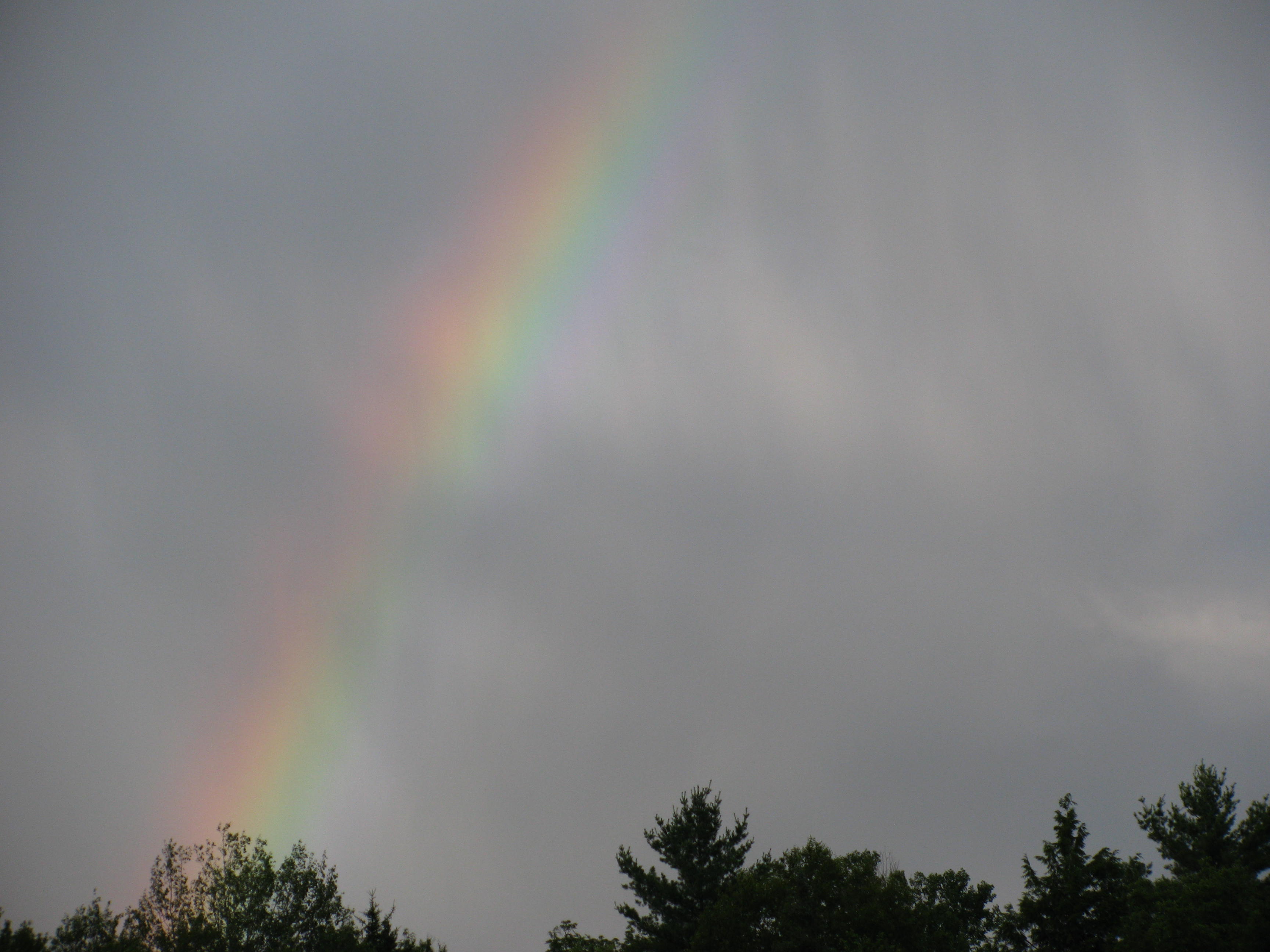
Rainbow in Vermont

One of my favorite jokes revolves around our own responsibility to seize miracles.  In the joke, a gentleman whose house is about to flooded gets a knock on the door from the police who urge him to evacuate. ” No,” he says, “the Lord will take care of me.”  After the waters have overwhelmed the street, rescue workers in a boat again urge him to come with them to safety.  “No,” he replies, “the Lord will take care of me.”  Eventually, the flood forces him to his roof, where he’s spotted by a helicopter.  The crew tries to airlift him, but, you guessed it, he once more says no, the Lord will take care of him.  Finally, as the waters rise to his head, he cries out, “Lord, Lord, why didn’t you help me?”  The Lord’s voice booms back, “I sent you the police, a boat, and a helicopter.  What more did you want?”

From the ridiculous to the sublime … That joke reminds me of a Helen Keller quote, “When one door of happiness closes, another opens.  But often we look so long at the closed door that we do not see the one which has been opened for us.”

We’ve got to do our part, and, we’ve got to pay attention.

Here’s another favorite joke (and I apologize if it sounds a tad sexist): Two construction workers sit down to eat lunch.  One opens his lunch pail and says, “Darn!  Peanut butter and jelly again.  I hate peanut butter and jelly!”  The next day, same two workers, same lunch pail.  Again the worker says, “Oh, no, peanut butter and jelly again!!  Drats!!”  The third day (you probably can guess where this is going), there they are again.  Once more, the pail is opened.  “Peanut butter and jelly!” the worker cries.  “Arrrrggghhhh!”  Finally his co-worker can’t take it any more and says, “If you hate peanut butter and jelly so much, why don’t you ask your wife to make you something else for lunch?”  The first worker is incredulous.  “My wife?!?  My wife?!?! I made these sandwiches.

The wisdom in this joke has served me well for decades.  On countless occasions, when I’ve been in a situation not altogether to my liking, and started to complain, either my husband observed, or I noted myself, ” I know, I know, I made this peanut butter sandwich.”

Funny thing, though, I realize as I write this that I only ascribe that joke to non-happy situations.  I need to start giving myself credit for making something else — maybe VT cheddar and apples? — in good times!  You and I and everyone else — we make our own happy choices, and do the work required to fulfill their promise.

We can further maximize the miracles by helping others learn to be happier.  Last week, I had the opportunity to do some mediation work with Jeff Mandell, founder of the Vermont Institute on Health.  This Institute is a camp for teenagers who want to learn more about genuine well being.  Jeff is helping these kids build a foundation for a lifetime of happiness.   As you can see in his video, there are a lot of miracles at his camp — along with mindfulness and hard work.  Go Jeff!! Read the rest of this entry »

Thanks to a passionate lesson in poetry from Anne Loecher, I now know the answer is — both.

Anne introduced her happiness poetry workshop by sharing the poem titled “Happiness“, by Jane Kenyon.  The poem begins:

“There’s just no accounting for happiness,
or the way it turns up like a prodigal
who comes back to the dust at your feet
having squandered a fortune far away.

Immediately I felt the need to interrupt.  “But Anne,” I said, “there is so accounting for happiness.  Scientists have researched happiness, and can say what leads to greater happiness, and what undermines it.  Happiness isn’t that mysterious.”

Balloon happiness

Fortunately, Anne was patient with me.  She gently but firmly suggested I try being a little less literal, that I listen for the magic, for the beauty, for the musicality, for the miraculous.  And, fortunately, I had the good sense to take a deep breath and try again.

The poem goes on:

“And how can you not forgive?
You make a feast in honor of what
was lost, and take from its place the finest
garment, which you saved for an occasion
you could not imagine, and you weep night and day
to know that you were not abandoned,
that happiness saved its most extreme form
for you alone.

No, happiness is the uncle you never
knew about, who flies a single-engine plane
onto the grassy landing strip, hitchhikes
into town, and inquires at every door
until he finds you asleep midafternoon
as you so often are during the unmerciful
hours of your despair.

It comes to the monk in his cell.
It comes to the woman sweeping the street
with a birch broom, to the child
whose mother has passed out from drink.
It comes to the lover, to the dog chewing
a sock, to the pusher, to the basketmaker,
and to the clerk stacking cans of carrots
in the night.
       It even comes to the boulder
in the perpetual shade of pine barrens,
to rain falling on the open sea,
to the wineglass, weary of holding wine.”

Gorgeous.  Stunning.

Of course, I could say, equality in life circumstances is crucial to happiness.  That is, if you are a monk in a cell, and you have more or less the same amount of possessions and quality of life as those around you, you can settle into happiness — though a monk coveting the possessions of a handsome young wealthy neighbor would be less happy.  Or, I could suggest many specific reasons why that clerk is happy.  Or question the viability of genuine happiness for the pusher.  Etc.

Or …  I could and did decide to just sit with the beauty of the poem, savor the poet’s insight, and appreciate the ineffable and unknowable qualities of happiness.  For me, this revelation also opened my heart to the value of poetry itself, more open than I’ve been since my teens.  It was a transforming moment.

Our conversation about Jane Kenyon’s poem reminded me of a recent feed from the online service, The Daily Good, which explored the scientific underpinnings of Bobby McFarrin’s classic song, “Don’t Worry Be Happy.”  According to that article, McFarrin got the “why” just right.  And yet … perhaps the mere existence of that brilliant piece of art is nothing short of miraculous.

To be clear, given our messy and unhappy world, particularly the threats posed by climate change, I believe it is critically important to individually and collectively understand the scientific underpinnings of happiness much, much better than we do.  We need this understanding as a guide for making wiser choices than our GDP-obsessed culture currently presses on us.

And, thanks to poetry, I have been reminded of the wisdom in both approaches to happiness.  Yes, it is miraculous.  Yes, it can be scientifically understood, quantified, and predicted.   Just typing those two sentences makes me smile.  How cool to hold both concepts as valid!

Here’s something else that’s smile-inducing: a link to the Daily Good article analyzing “Don’t Worry Be Happy”  and, a video of Bobby McFarrin the song itself:   http://www.dailygood.org/view.php?sid=105  Together, they prove the point quite nicely!

In his brilliant book, The Great Disruption: Why the Climate Crisis Will Bring on the End of Shopping and the Birth of a New World, environmental activist and academic Paul Gilding writes that we are headed toward a “happiness economy.”

Of course, we won’t get there easily.  Systems and individuals alike are heavily, heavily invested in the growth economy and will not give up gently.  Gilding posits that economic and environmental disasters will inevitably force the change.  In his discussion of the transition “away from our current obsession with personal material wealth,” he states:

“We need to start thinking now about what this new economy is going to look and feel like.  I don’t harbor any delusions that we’re going to move to this in the next few years, but we are going to at some point, so the more we consider, debate, and experiment with the ideas involved, the better off we’ll be when the time comes.”  (p. 200)

In other words, as I see it, building the new happiness paradigm will take an enormous amount of creativity, from countless numbers of us, each in our own way.

Yesterday, two visionary members of the Vermont legislature — Representative Susi Wizowaty (D) and Senator Anthony Pollina (P) — introduced a series of forward-looking bills, including one to use a Genuine Progress Indicator (GPI) to guide budgetary policy decisions.  I think of GPI — which the state of Maryland already uses — as sort of a politically acceptable way to sell the Gross National Happiness concept to lawmakers.

So that’s one way.  Encouraging wide-ranging and collaborative thinking through the arts is another way — one more suited to me, that’s for sure.  The idea of zeroing in on poetry specifically came from discussions with my good friend and across-the-street neighbor Anne Loecher, who just received her M.F.A. in poetry from Vermont College of Fine Arts last week.  With her as a resource, launching a Happiness Poetry Project is a natural choice.   Through this project, we can more deeply and yet playfully explore what each of us thinks happiness looks like for individuals, the community, and Planet Earth.

Poet Anne Loecher, discussing ways to kick-off The Happiness Poetry Project

The project, which we will officially kick-off at The Happiness Paradigm Store and Experience in Maple Corner on January 21st from 11 AM to 3 PM, will give Anne a chance to share some of her knowledge.  She will give provide potential poets of all ages and skill levels with ideas, information about structuring poems, inspiration, and generally good vibes.  I’ll pass out my list of 18 happiness tips.  And, Anne is  adding extra happiness to the day by offering to bake chocolate chip cookies!

In 2011, David Budbill, an accomplished and popular poet from Vermont’s Northeast Kingdom, published Happy Life.  His poems are personal reflections, yet seem to fit well with a happiness economy paradigm that measures a life well lived according to one’s work, family, community, time in nature, and simple pleasures.

With the Happiness Poetry Project, we can all take a turn.  Haikus, sonnets, limericks — whatever suits your fancy.  You can be whimsical or exceedingly serious.  And you don’t need to live anywhere near Vermont, much less Maple Corner, to join this project.  Just email your contributions to: Happinessparadigm@gmail.com.

I’m also going to try my hand at writing happiness poetry.  I wrote reams of poetry in high school, and again in my mid-20’s — until an acquaintance who taught poetry termed my work simplistic and one-dimensional.  The heck with that kind of thinking!  Now is the time to encourage creativity, not quash it.  I’ll be brave. How about you?

Contemplating happiness poetry will benefit us individually, also, by helping us focus on what we really care about.  In Living A Life That Matters, Rabbi Harold Kushner writes of “a Native American tribal leader describing his own inner struggles.  He said, ‘There are two dogs inside me.  One of the dogs is mean and evil.  The other dog is good.  The mean dog fights the good dog all the time.’  Someone asked him which dog usually wins, and after a moment’s reflection, he answered, ‘The one I feed the most.'” (p.58-59)

To me, this story is all about where we put our energy, our thoughts, and our time.  Thus, even though I’m a cat owner, I have to say, let’s feed our happiness dogs with some good poetry thoughts.

From the Statehouse to the school house, Vermonters are on the happiness path!

Two days from when I’m writing this, there will be a big press conference in Montpelier announcing three new visionary ways for lawmakers to “Build a Better Budget.”  Representative Suzi Wizowaty (D) and Senator Anthony Pollina (P) will introduce three new bills.  The first one proposes a Genuine Progess Indicator, much like a Gross National Happiness paradigm for policy making.  Indeed, GNHUSA co-coordinator Tom Barefoot will speak at the press conference.

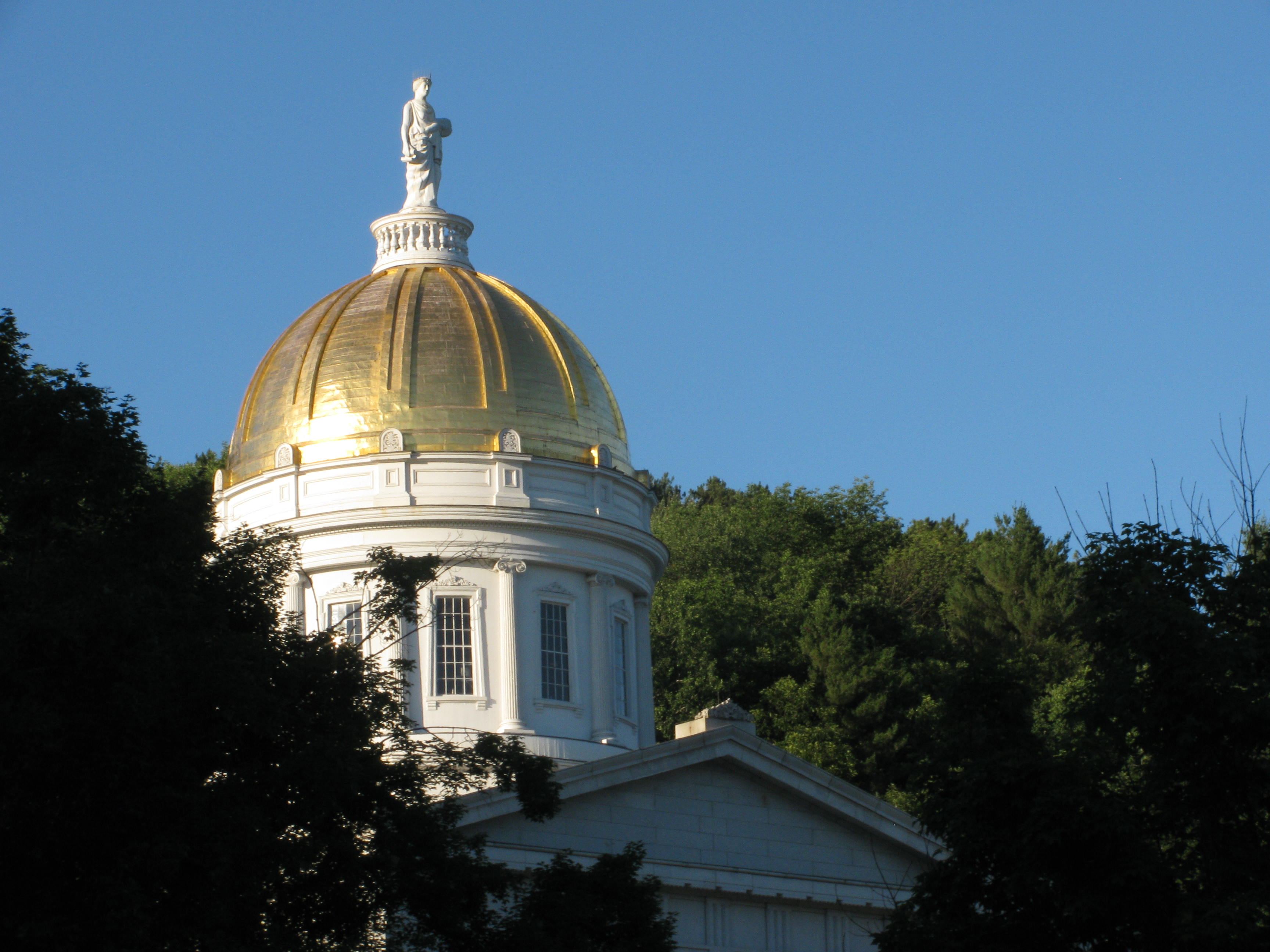
The “Golden Dome” that tops the Vermont Capitol Building

Bill number two will address income inequality.  As this brilliant TED talk by Richard Wilkinson illustrates, income inequality is perhaps the most corrosive threat to societal happiness.  http://www.ted.com/talks/richard_wilkinson.html  We simply must, must address this threat to well being.  The income inequality gap is dragging us all down.

The third bill seeks to create an expert panel to to explore the development of  a State Bank in Vermont.  I frankly know next to nothing about this idea.  If you all have thoughts to share here, please do!

If you are in the Montpelier area, and want to stop by, you’re welcome to come to the press conference: January 17th, 2012, 1:00, in the Cedar Creek Room in the Statehouse.

Meanwhile, in the school house

Liza Earle-Centers, a fifth and sixth grade teacher at Calais Elementary School, shared a poem compiled from her students’ writing after watching Dr. Martin Luther King’s 1963 speech.  I’d say their wisdom is a pretty good guide to a much happier world.  Here it is:

Our Dream
I have a dream that one day everyone will have a friend.
I have a dream that one day people who are poor will get homes and food.
I have a dream that one day all humans will be equal in money, and in health—that no one will be hungry or forced to work to death.
I have a dream that everyone will have food and water and that no one in this world will starve.

I have hope and faith we will be able to help endangered animals, give them homes and treat them well.
I have a dream that people will stop abusing animals.

I have a dream that one day everyone will be safe.
I have hope and faith that we will be able to adopt kids that need help, be there for them and give them care.
I have a dream that all kids will get their own rights and learn to have some kind of freedom.

I have a dream that one day all people will be nice to each other.
I have a dream that one day, everyone can just be friendly, not mean or hurtful.
I have a dream that we will stop the flow of harmful words.
I have a dream that one day we will stand up against bullying and that bullying will stop.
I have a dream that that the people who were getting bullied will be happy.

I have a dream that everyone, no matter what race, will be friends not foes.
I have a dream that one day there will be no nuclear bombs or nuclear power of any kind.
I have a dream that one day this nation will make peace with other nations.
I have a dream that one day this whole world will be in peace, and that angry wars will come to an end,

I have a dream that one day everyone will show the people of the world that they care about what they need.
I have a dream that one day our nation’s weak will be strong, and the strong will be stronger.
I have a dream that our nation will carry on together and with strength.

I have a dream that one day everyone will get along.

Along with the legislators, the children” words inspire hope in me that Vermont, at least, takes happiness seriously.

In my last post, I wrote of paradoxes.  Here’s another: to find genuine happiness, I believe it is important to accept — even embrace — your sadness.

This is a fundamental tenet for many spiritual leaders, in contrast to Western culture which encourages us to keep pain and suffering at bay.   The  Dalai Lama, for example, has written extensively on the intersection of happiness and suffering.  In The Art of Happiness, he observes that while upbeat Western views  can lead to “a happier and healthier life … the inevitable arising of suffering undermines these beliefs  … (Even) a relatively minor trauma can have a massive psychological impact as one loses faith in one’s basic believes … (and) suffering is intensified.” (p.147)

My mediation training also illuminated the importance of “leaning into the thorns,” as instructor Alice Estey put it.   Shining a light on difficult issues (there’s that mindfulness piece again!) provides the opportunity to get to the root of conflict — or any other source of sadness.  Appreciating the cause of pain is a good first step toward fixing or ameliorating the problem.

Sadness can even be a building block for happiness.  Through the commonality of suffering, we build relationships, community, and compassion.  It is sadness that provides the backdrop which allows moments of happiness to glow.

I had the opportunity to personally appreciate these benefits a few weeks ago when I woke up deep in the blues.  In addition to my own disappointments, I have a large family and many friends — some of whom were in the midst of crisis. It all weighed heavily on me that day.  I didn’t feel hopeless, and I didn’t feel like wallowing or being sorry for myself.  I was just sad.

I decided to write about my sadness on Facebook because I like to share my genuine emotions on my FB page.  Also, I don’t want anyone to think my focus on happiness means I believe anybody, me included, should try to be chipper all the time.

Immediately, I got that sweet boost of support Facebook friends can provide.   Simply, I felt the love — but I was still sad.  I read all my friends’ lovely messages, and just wanted to cry.  Obviously, I needed to embrace my sadness.

When I arrived at yoga that evening, still on the verge of tears, the most amazing thing happened.  A yoga classmate had a present for me.  Liz Snell said she and her husband John had thought of me when they were at a craft fair in July and spotted small, handmade happiness quote books.  Now, on this dark early winter night, she gave me the one they bought for me (pictured above).  I was surprised, moved, and grateful.

No doubt, if Liz had given me the book on a sunny summer evening when I was riding the wave of a good mood, I would have sincerely appreciated the gift — but not in the same way.  Now, every time I look at the book, or read from it, I have tangible proof that I am not alone in sorrow.  That is so, so comforting.

Giving from the heart, and receiving heartfelt gifts, are both manifestations of compassion.  I’ll close this blog with an observation on how suffering builds compassion from one of my all time favorite spiritual books, Living Your Yoga: Finding the Spiritual in Everyday Life, by longtime yoga teacher and Yoga Journal columnist Judith Lasater.  I love Lasater’s book because it’s so real, completely accessible — yet profound at the same time.  In the chapter on compassion, Lasater writes:

“The old axiom wins out.  Charity begins at home.  So, too, with compassion.  You must begin with yourself.  To be compassionate toward others, you must first understand that you suffer.  This awareness allows you to see that others suffer, too, and to respond with clarity to this condition, which is shared by all living beings.” (p.51)

So, to all you living beings, from another — here’s a heartfelt wish for a happy — and sad — New Year!

I love paradoxes, including this one: happiness is unique AND happiness is universal.  A chalkboard in front of The Happiness Paradigm A-frame captures individual responses to the question, “What makes YOU happy?”  Some of the recent answers have been doggie kisses; ukuleles; snow; Baby Charlie; and video games.  Not everyone likes video games or, if you can believe it, ukuleles.  And most of you don’t even know who Baby Charlie is!

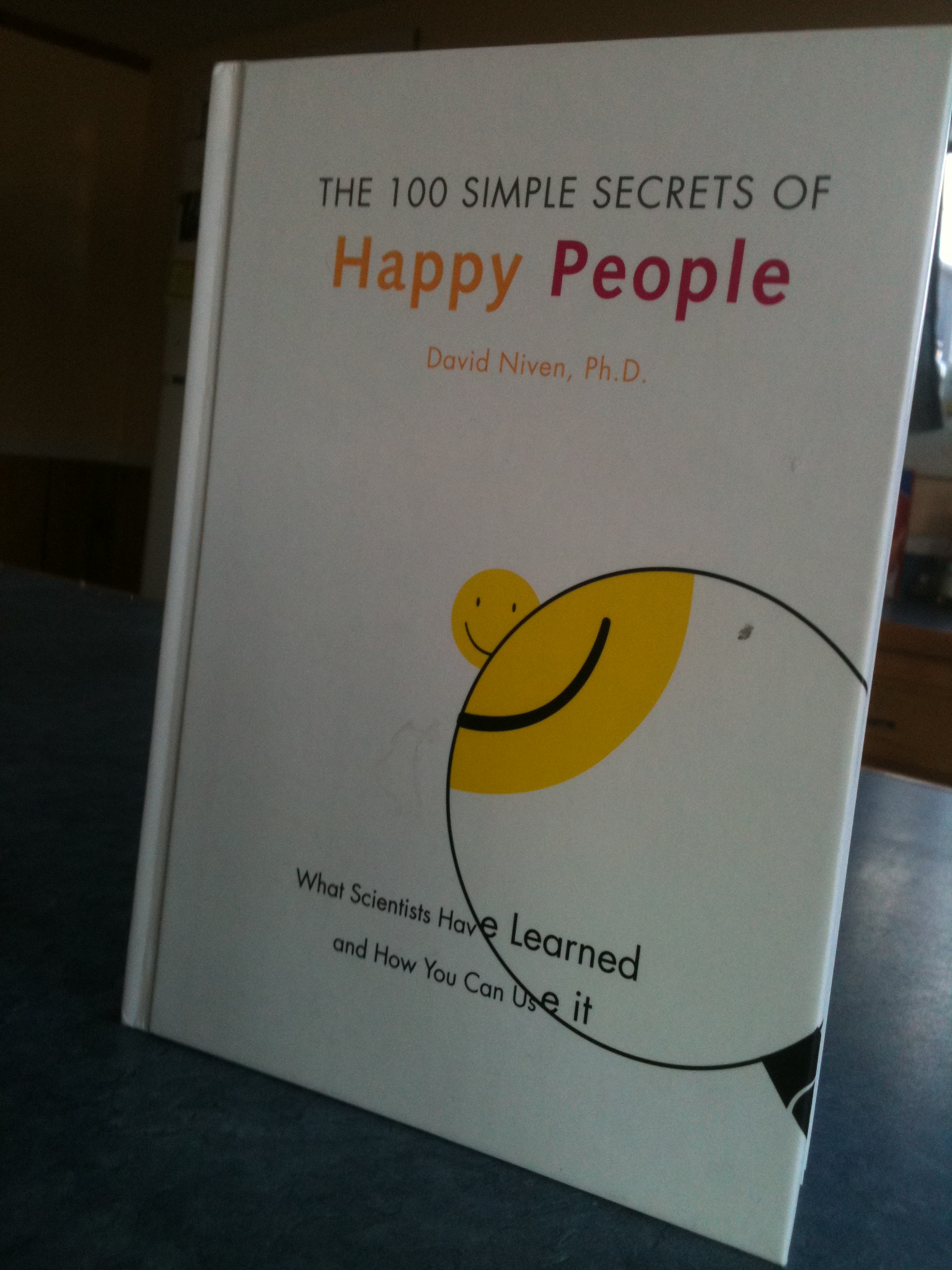
But happiness research, which started, oh, around the time of Aristotle, has found consistent paths to happiness.  Some of those ideas are captured quite pithily in a book my sister Peggy sent me, The 100 Simple Secrets of Happy People: What Scientists Have Learned and How You Can Use It,” by David Niven, copyright 2001.    For example, # 16 is “Believe in Yourself.”  #17, however, is “Don’t Believe in Yourself Too Much.”  Gotta love it.

In England, the New Economics Foundation — originators of the Happy Planet Index — has developed five keys to happiness: lifelong learning, connection with others, mindfulness, physical activity, and giving to others.  There’s a lot of good information at their website.

The Pursuit of Happiness project — a group of academics with a mission of teaching us all to be happier, has seven correlates to happiness: relationships, caring, exercise, spiritual engagement, positive thinking, flow, and strengths and virtues.  Click on the science of happiness tab at their website  http://www.pursuit-of-happiness.org/ for a fuller explanation.

Bhutan‘s Gross National Happiness policy grid for determining whether policies will actually lead to greater well being for the Bhutanese has nine pillars and 72 indicators. Most of these measurements fit well with our western culture.

Much more simply, I recently read that there are just three happiness fundamentals: feel good, do good, and be good.  Voila!  That’s all there is to it!

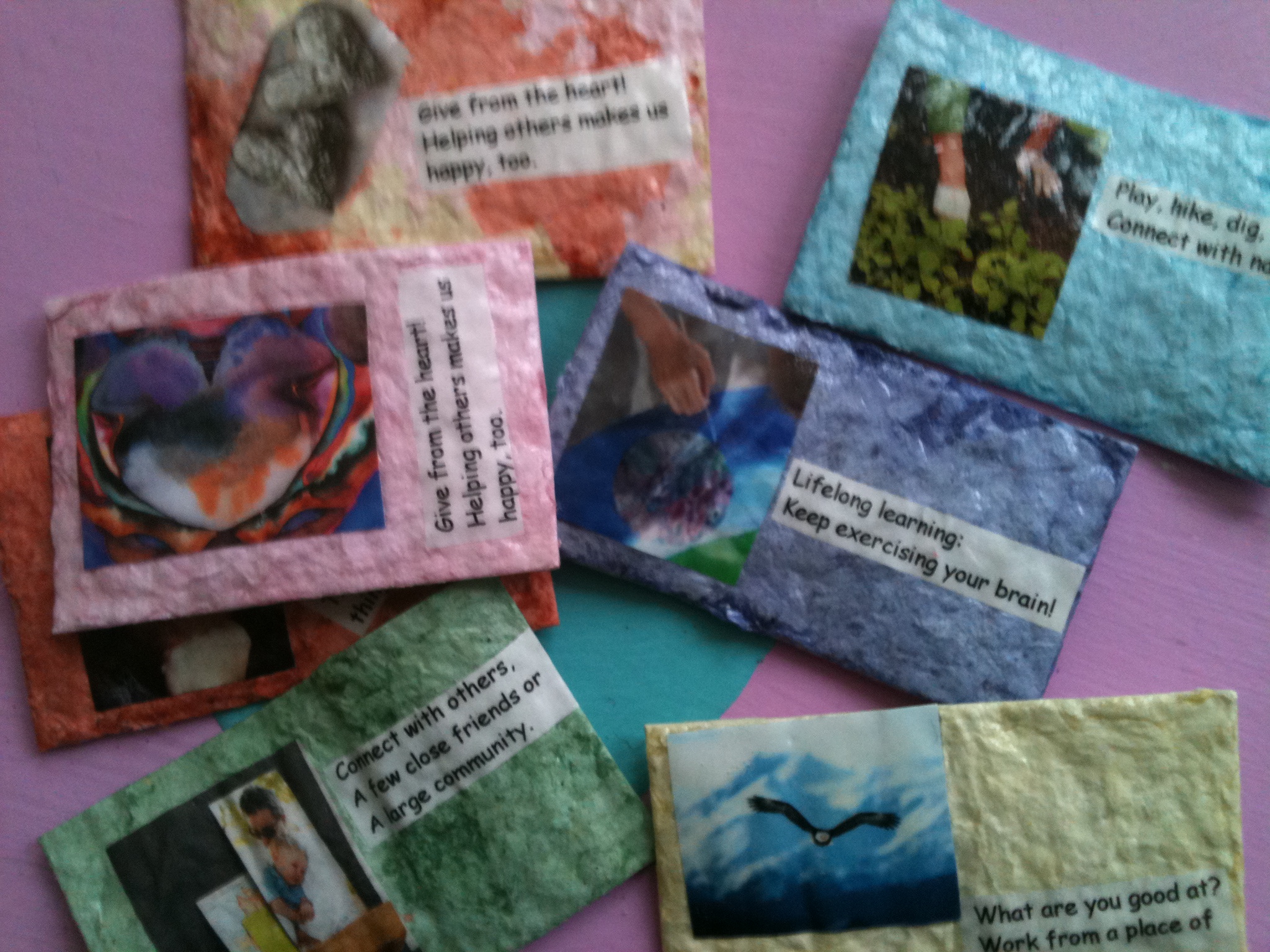
Happiness Inspiration Cards

I’m not a scientist or an academic, but based on my reading (including all the fine resources above), I’ve developed my own list of 18 happiness tips that are, hopefully, both accessible and personally meaningful.  I’m embedding these tips in handmade paper, illustrated with snippets from magazines and catalogues, that I turn into happiness inspiration cards and greeting cards. Here’s my list, in no particular order:

1. Connect with others: a few close friends, or a large community.

2. Eat well, & get a good night’s sleep.

3. Give from the heart! Helping others makes us happy, too.

4. There’s so much to be grateful for!  Be sure to say thanks.

5. Stay physically active. Take care of your body!

6. Play, hike, dig, breathe, swim, ski: connect with nature.

7. Get in the flow: create, exercise, sing, concentrate.

8. Measure your happiness.  Truly! We focus more on things we measure.

9. Foster a positive outlook.  Optimists are happier!

10. Resilience: bounce back when bad stuff happens (‘cause it will).

11.  Be creative! Write, garden, solve problems, paint, dance, cook!

12.  Be a lifelong learner – ie, keep exercising your brain!

13.  Mindfulness: Be aware of the world around you, and within you.

14. What are you good at? Work from a place of strength.

15. Happiness is universal AND unique. What makes YOU happy?

16. Tread lightly on Earth.  If Mother Nature ain’t happy, ain’t nobody happy.

17.  Have a purpose. A meaningful life is a life with meaning.

18. Nurture your spirituality, whatever that means to you.

Phew!!  So many ways to be happy!  I’m sure you all have more, and I would love to hear what they are.

Is Shopping Bad?

Having just opened a store, albeit a highly unconventional one, I think you can safely assume that I do not believe shopping is bad — not entirely, at any rate.

Shopping has been getting a lot of negative attention lately.    This year’s Black Friday videos were disgusting and distressing —  particularly the one of the woman who couldn’t stop to pull up her pants lest she lose out on a $2.00 waffle iron.   Our cultural obsession with accumulating more stuff is not making us happier individually or collectively.  It also wreaking havoc on the environment.   If you haven’t yet watched “The Story of Stuffhttp://www.storyofstuff.org/movies-all/story-of-stuff/, I highly recommend you do so.  It will be 20 minutes well spent.

And it alternately makes me sad or pissed off to hear even National Public Radio extolling the glories of higher holiday shopping totals.  Yo, NPR, wake up: more Walmart sales are a nightmare.

Yet …  I think the shopping story is more complicated than that.  Many people — me included — find shopping to be a fun activity.  Farmer’s markets are highly social, and, I think beneficial to community well being.    Speaking of community building, this summer I participated in a community-wide yard sale, which was great fun.  Shoppers and sellers alike were all smiles.

Further, not all shopping afficionados can be easily pigeonholed.  For example,  a six year-old boy who I’ll call Max lives across the street.   His family is loving and attentive.  They are hard-working Vermonters who grow their own veggies, raise chickens and heat with firewood they cut and stack themselves.  And … Max loves to shop! When he came in my store, he excitedly told me that his town now has two stores!  (Our town is very small.)

I offered to teach Max how to make paper, but he was much more interested in shopping.  His mom finally went home, while Max continued to carefully consider every item in the store.  Eventually, he chose two flowers made from old produce wrappings.  Then he happily went home.

Sometimes I think people turn to shopping to fill a spiritual emptiness.  Or, to get another fix of the temporary high of a new purchase.

But maybe we’re hard wired to shop.  What if it’s part of our hunter-gatherer instincts, a basic survival skill?

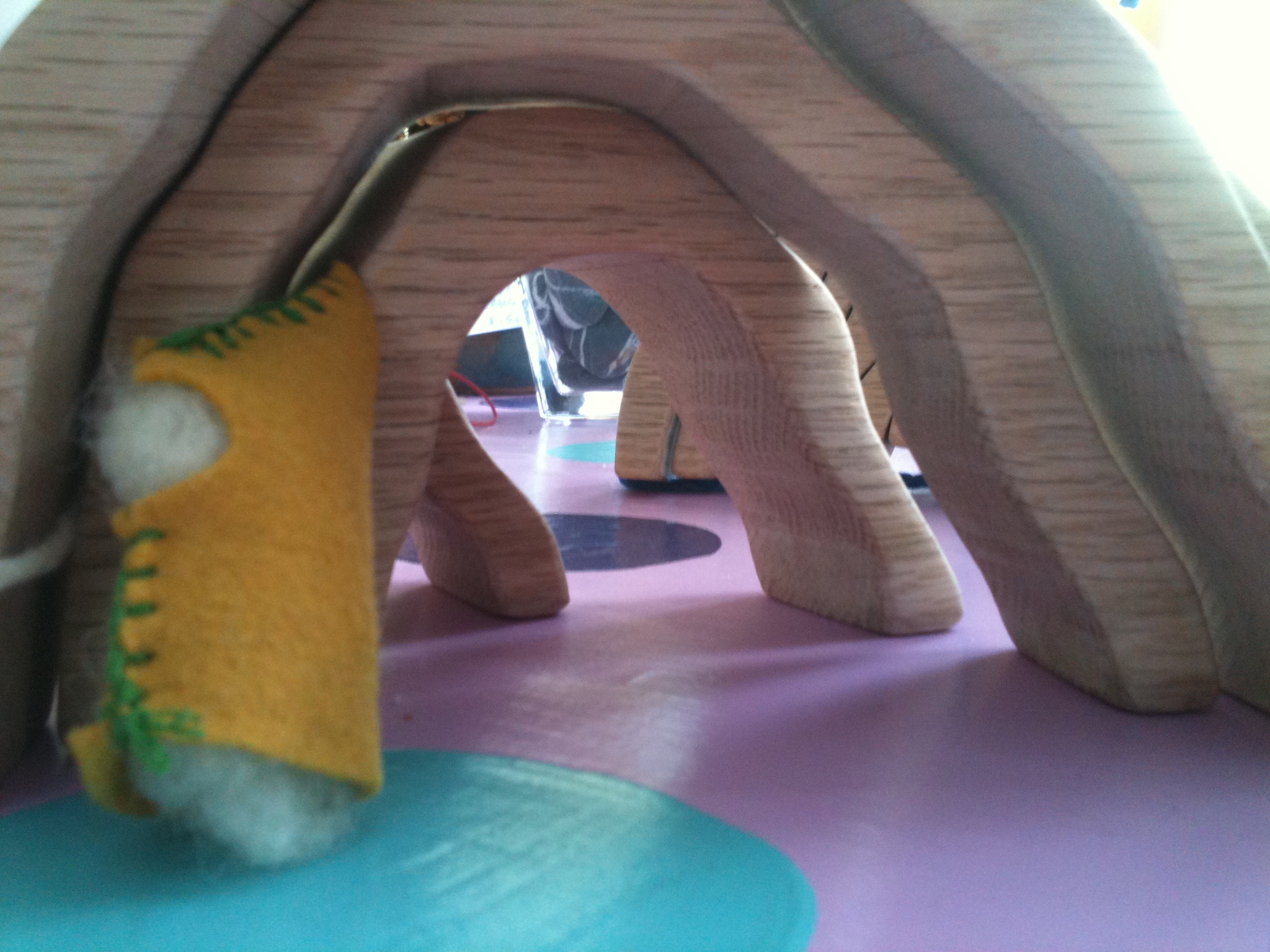
In any case, I suspect we can more easily move toward a happier, more environmentally sustainable world if we create new — or recreate old — ways of shopping that honor the work of tradesman, artists, farmers, etc. while not adding to landfills and pollution.  When I look at the gnome caves (pictured above) that were crafted by Rob Smart, Maria Smart, and Hannah Smart from leftover materials, I am hard-pressed to see anything “bad” about selling them.

Perhaps, as with so many areas of our lives, the key to “good” shopping is mindfulness.   We need to be aware of our shopping choices, because the impact of poor shopping decisions can be extraordinarily negative — not only on our own unhappy psyches but on others we’ll never see or know.

In The Right Attitude to Rain, one of Alexander McCall Smith‘s Isabel Dalhousie books, Dalhousie’s ponderings remind me of the moral necessity for shopping mindfulness.   Dalhousie, a fictitious philosopher and editor of the Review of Applied Ethics, had published a discussion of “the lifeboat question.”  That is, if a ship is sinking and there are not enough lifeboats to go around, how do you decide who to save?

Then, Smith writes:

“…the focus moved on from real lifeboats, which were, fortunately, manned by sailors rather than philosophers, to the earth as lifeboat, which it was, in a way.  And here the issues became very much ones of the real world, Isabel thought, because real people did die every day, in very large numbers, because the resources of the lifeboat were not fairly distributed.  And if we might feel squeamish about throwing a real and immediate person out of a real lifeboat, then we had fewer compunctions about doing those things which had exactly that effect, somewhere far off, on people whom we did not know and could not name.  It was relentless and harrowing — if one ever came round to thinking about it — but most of our luxuries were purchased at the expense of somebody’s suffering and deprivation elsewhere.”  (p.221,The Right Attitude To Rain.)

I’d say it’s definitely time “to think about it.”  As my daughter might say, “For realz.”