Genuine well being for ourselves and the planet

Archive for the ‘Personal Happiness’ Category

Is Happiness Escapist?

Is happiness escapist?

This question, which came up at a happiness workshop on a lovely Sunday afternoon in Vermont a little over 24 hours before Super Storm Sandy hit the U.S.,  carried extra weight in the following days as we witnessed the storm’s massive destruction and personal tragedies.  Most painful was the news about a Staten Island woman whose two young sons were swept from her arms by powerful waves as she tried to carry them to safety.  Both little boys drowned.  I cried at her despair.

Even worse, though, is the foreboding I feel.  I know I am not alone in believing Sandy is the new “normal.”  I suspect there will be many more neighborhoods aflame, beautiful beaches and treasured covered bridges washed away, and toddlers dying.

And, we all have our normal garden variety of suffering to deal with: aging, failing bodies; money worries; heartbreak from our own and others’ failings; and, ultimately, death.  For all of us.

In fact, I’m feeling a little sad while I write this blog.  Yet, on both a micro and macro level, my answer to the title question is a resounding no.   Quite the opposite, really.  For me, cultivating happiness, positivity, and well being is a moral imperative on both the big systemic and deeply personal levels.

Some of the water jugs we had filled in case Sandy knocked out our power for an extended time.

Why?  Most urgently, because, on both a personal and societal level we are chasing the wrong goals: money and material success.  I know that is not all that many of us seek.  We are also spiritual beings, who treasure and nourish relationships and the opportunity to do good and to create.  And we are physical creatures, who dance and have sex and go to yoga class. Nonetheless, because our economy is fixated on growth, the pressure on us to buy and spend is enormous.  The resulting consumerism is trashing the environment.

To begin to ameliorate the insidious, unpredictable effects of climate change, we must reject the sacred cow of a growth economy.  Equally, we must understand that a rising Gross Domestic Product (GDP) is not a valid  indicator of a flourishing society.  This is not a new idea; Bobby Kennedy eloquently articulated the flaws of GDP way back in 1968.  I’ve watched a video of his GDP speech many, many times and it still moves me to tears.  Today, viewing it again, I want to add “the ravages of a hurricane” to RFK’s list of what contributes to a “healthy” GDP.

One other quick primer on how destructive consumerism is:  “The Story of Stuff.”  If you haven’t watched it yet, I highly recommend investing the 20+ minutes this smart, sassy video lasts.  And, BTW, happier people shop less.

But what will take the place of a growth economy, consumerism, and GDP? Something needs to fill the vacuum.  That something should be a Gross National Happiness (GNH) paradigm — or, in more politically palatable terms, the genuine well being of people and the planet.  Systemically, embracing happiness is embracing a sustainable future.

On the personal level, first of all, I have to question what good it does anybody for me, or you, to be unhappy?  How is that going to help fix anything?

But it’s not just me.  Sages from across the millenia — the Dalai Lama and Aristotle, for example — say that happiness is what all humans desire.  The Dalai Lama has also written that whenever we interact with another person, we can add either to that individual’s happiness or to their unhappiness.  Thanks to mirror neurons, we are much more likely to boost another’s spirits if we ourselves are in a happier place.

When I was at the national happiness conference in Seattle in August, I learned a simple but profound exercise from Scott Crabtree, proprietor of “Happy Brain Science.”  Scott divided the group into paired-up “A’s” and “B’s” and then instructed the “A’s” to maintain sober facial expressions while looking at the “B’s” who were instructed to smile, smile, smile at their partners.  You can guess, it is just impossible to not smile back!

Of course, I am not recommending fake cheeriness or inauthentic saccharine behavior.  What I am suggesting is, as Christine Carter puts it in Raising Happiness, that we need to “put on our own oxygen masks first” when it comes to helping others be happier.

Thanks to positive psychology research and multiple other studies on human behavior, we now know that nurturing happiness builds our own ability to respond to crises and to serving others in their moments of need.  Positivity breeds greater resilience, and the ability to see and appreciate silver linings.  Happier people are kinder — and kinder people are happier.  Happiness is also good for our health, and, damn, sometimes we need to be strong and healthy to fight the good fight!

Another powerful argument for strengthening our happiness muscles is the value of mindfulness.  Taking time to meditate and build personal awareness is one of the most important happiness strategies any of us can adopt.  With mindfulness comes greater compassion (for ourselves and others), more inner peace, less stress — and, the ability to make better decisions.  “To lead a happy life, we need to make good choices,” write father and son happiness mavens Ed Diener and Robert Biswas-Diener, “and this involves the recognition that problems arise, even in good circumstances”  (Understanding True Wealth, p. 18).

The circumstances in North Central Vermont were very good indeed — a sunny, warm, late autumn day — as Sandy was headed our way.  Even way up here, we were warned of very high winds and the likelihood of losing power.  It was time for mindfulness and good decisions: after watching Tropical Storm Irene devastate much of Vermont last year, we knew that if the power went out, it could stay out for a long, long time.  Our wood stove and gas range meant we could stay warm and cook hot meals.  But our well needs electricity to work, so we stockpiled pitchers, jars, trash cans, and bottles of water to drink, clean, take care of the baby, and flush the toilets.

The storm wobbled a bit to the west and we never needed all that extra water.  But the threat was — and is — quite real.  My sister Peggy in New Jersey is now in Day 8 of no power, no heat, no water.  It is, she says, “the pits.” I can’t regret for a moment my choices to stockpile water; I am grateful for mindfulness and the awareness to “be prepared.”  (After all, I was once a Girl Scout!)

Diener and Biswas-Diener also observe, “challenges look easier when you are happy.”   I’ll tell you something else that makes my challenges look easier: coffee!   I don’t drink a lot, but, oh, that first cup in the morning is a savoring experience every single day.  During our preparations for Sandy, I became very mindful that I had wholly inadequate coffee preparations.  Next time, I will make even better choices, stocking up on coffee (ground!) as well as water.

That’s not a moral imperative, of course — but, it will help me keep smiling!

Happiness Is A New Baby!

Happiness is a new baby — especially when that baby is a much longed for, dearly treasured grandchild.  Meet the newest addition to our family: Madeleine Arden Sassaman, shown here at six days old.

My granddaughter Madeleine, six days old.

It’s a no brainer that new babies bring joy.  They are fresh, innocent, full of hope and potential —  the personification of pure love.  Most people respond with warmth and smiles to a baby, any baby.  That reaction is magnified a million fold when the baby is near and dear to your own heart.  Some life events cause our natural happiness levels to soar dramatically; Madeleine’s arrival is the happiest event I can even imagine.

I won’t try to over analyze this most obvious of happiness highs.  But I do want to highlight a few fundamentals of day-to-day personal happiness that my granddaughter’s  birth brought into sharp relief.

First, savoring.   Over and over in Madeleine’s first week, I watched her mother delighting in her every detail — the perfect fingers, the amazing tiny toes, her head of silken hair, soft breaths, ability to hold her head up, etc.   Jennifer just drank in every aspect of Madeleine.  “I don’t want her to ever change,” Jennifer sighed.  “She’s perfect right now.”

New babies are scrumptious — but more ordinary opportunities to savor are multitude in our daily lives.  For example, as I rocked my grand baby on the front porch this morning, I could also savor the beauty of pink balloons wafting across a leafy green and sky blue background.  Earlier, I savored the coffee that helped wake me up before going on baby duty.  I could hear birds, and my daughter’s laugh, and watch butterflies, bumblebees and wild flowers.  All this, in an ordinary neighborhood in a rural southern town.  Here, there, everywhere, we can savor away … The very thought is enough to make me smile.

Gratitude.   Jennifer went into the birth experience somewhat apprehensive of hospitals and modern medicine and determined to have a natural birth — but that was not to be.  Despite many, many hours of excruciating pain, Jennifer’s cervix did not dilate enough for the baby to come out the birth canal.  Without an epidural, my daughter’s agony would have been unspeakable.  Worse — in another time and place, when C-sections weren’t viable options, Jennifer’s situation may have led to both maternal and infant death.  Maybe I’m wrong, and maybe that’s over-dramatic — but both she and I are very grateful to Doctor Jennifer Logan and all the compassionate and skilled staff at Montgomery Baptist East Hospital for providing the care that meant a happy, healthy homecoming for mommy and baby.

This is gratitude writ large, for sure.  Also, for sure, we all have many reasons to be grateful every day.    Today, I have been grateful for things large and small — like Madeleine finally falling asleep and a well-stocked refrigerator as lunchtime drew near.  Like savoring, the opportunities for gratitude are always at hand.  We need only invest a conscious effort in acknowledging our appreciation.

Community.  While I would never want to relive my daughter’s labor, I will always treasure that night.  The community gathered around Jennifer — the baby’s dad, the doctor (on-and-off), Jennifer’s best friend and the friend’s teenage daughter, and I — shared her sacred journey.  We laughed, cheered, cried, wept, ate, slept, and waited during a period of time in which no reality existed beyond Jennifer’s efforts to give birth.  As we supported Jennifer, we also leaned on each other literally and emotionally.  We were intensely connected.

The next day, as I walked past the labor room on my way to Jennifer’s hospital room, I felt a pang of nostalgia.  There was so much love and beauty in that one-time-only community!  It was a powerful reminder of the importance of building and maintaining community connections in our “regular” lives.

Then there’s money. It is costing me a lot of lost income to be with my daughter and granddaughter for a few precious months.  I live in Vermont, my daughter lives in Alabama.  To be here, I had to close my “Happiness Paradigm Store and Experience” for two months, and turn down other income-generating opportunities. Plus, the trip here and back — by car, and staying with friends — is pretty pricey.

I am not entirely sure how I’ll pay my bills over the next few months, but there was really no question about what I should do.  How could I have possibly chosen money over the opportunity to be with my daughter before, during, and after she gave birth?

This is a particularly valuable lesson for me personally.  I constantly struggle between the desire to move away from the demanding paradigm of making more money, and the desire to actually make more money.  Perhaps my choice this spring will help me find greater comfort and balance around money questions in the future.

One last observation: caring for a newborn and the newborn’s mother is hard work — so much so that I haven’t found time to invest in my specific happiness strategies since Madeleine was born.  I haven’t meditated, done yoga, sung in the choir, written in my nightly positive journal, or painted a gratitude watercolor in weeks.  I miss those practices, but Madeleine has lusty lungs and will not be ignored.  Soon enough I’ll go back to Vermont, where I will no doubt pine for the hours of rocking this infant to sleep. I love her.  That love fills me with more than enough happiness for now.

Universal and Unique Happiness

“What makes YOU happy?” That’s the question I have on a chalkboard by the entrance to The Happiness Paradigm.  Everyone who stops by is invited to write their own answers.  I occasionally step outside and add something myself.  I confess, I was the one who wrote “Bruce Springsteen,” after listening to his totally happy version of Santa Claus Is Coming to Town.

The “What Makes You Happy” Chalkboard

I also lead “Happiness Circles,” where we discuss the same question.  Naturally, in that context, the answers are more nuanced and less light-hearted.  No matter the forum, “family,” “friends,” and “pets” crop up frequently.  (See the “What Makes You Happy” page on this website for a complete list).  Such answers resonate with me.

Some answers, though, give me pause —  “style,” “video games,” and “money” — because they don’t fit neatly into my view of happiness as influenced by Positive Psychology and Gross National Happiness research.  Obviously, happiness at the individual level is  universal, unique, and complex!

I suspect the same is true at the state level; many answers I’ve collected have a Vermont-specific focus.  A lot of people here answer “snow” — a choice that probably wouldn’t show up at all in most southern states.

This universality/uniqueness balancing act no doubt applies even at the national level.   Bhutan, the first country to put theoretical GNH concepts to work, has conducted a great deal of detailed research, for which the rest of the world should be grateful.  Researchers there developed a measurement system of 72 indicators within nine pillars of happiness: psychological well being, standard of living, time use, good governance, health, education, community vitality, and cultural diversity and resilience. http://www.grossnationalhappiness.com/ These pillars and indicators are an amazing foundation for other governments to build on.   But are all the Bhutanese findings appropriate to policy making in the U.S.?  In Vermont?  In Seattle?  We need to do our own homework.

And when we do our homework — for personal, political and/or professional reasons — we need to investigate a variety of sources and schools of thought.  A recent blog from the Seattle-based Happiness Initiative, happycounts.blogspot.com, illustrated this point with an essay on the restrictive nature of Positive Psychology formulas.

Interesting.  I find that Positive Psychology theories do, for the most part, encompass responses on my chalkboard.  The Positive Psychology categories are BIG, certainly, while individual perspectives are more textured and colorful.  But they still seem to fit.  Chocolate, red wine, Bruce Springsteen and toes in the sand all relate to savoring.  Pets, cousins, and friends? Connections.  Singing in the choir — a very happy experience for me — fits in multiple categories: giving to others, being in the creative flow, lifelong learning, building community, nurturing spirituality, and even, a little bit, being physically active.

Where Positive Psychology falls short for me is its lack of emphasis on the environment.  In November 2010, I attended an otherwise wonderful seminar on happiness from a psychological viewpoint, but there was NO connection with the planet.  Yet many people tell me what makes them happy is weather related, especially sunshine and snow.  Or nature related, like walking in the woods.  With Climate Change, the importance of environmental factors is bound to increase.  I imagine folks living in areas subject to fires and droughts might answer that rain would make them very happy indeed.

Fortunately, other sources do talk about weather and nature.  For example, Dan Buettner‘s book Thrive posits that sunshine can definitely be a factor for community-wide happiness.  Another example is the New Economics Foundation‘s “Happy Planet Index,” which blends carbon footprint considerations with more traditional gauges of societal well being to measure national well being.

The take away for me is, we need to continue to learn as much as possible about happiness from a wide variety of sources.  Fortunately, there are such rich resources! TED talks, books, articles, videos, webinars… Just this week, thanks to the Happiness Initiative folks, I found a single site that’s an absolute gold mine of learning:  the Aspen Ideas Festival Happiness Track from July 2011.  This site alone will keep me busy for a while!  (more…)

New Years Eve: Embrace Your Sadness

In my last post, I wrote of paradoxes.  Here’s another: to find genuine happiness, I believe it is important to accept — even embrace — your sadness.

This is a fundamental tenet for many spiritual leaders, in contrast to Western culture which encourages us to keep pain and suffering at bay.   The  Dalai Lama, for example, has written extensively on the intersection of happiness and suffering.  In The Art of Happiness, he observes that while upbeat Western views  can lead to “a happier and healthier life … the inevitable arising of suffering undermines these beliefs  … (Even) a relatively minor trauma can have a massive psychological impact as one loses faith in one’s basic believes … (and) suffering is intensified.” (p.147)

My mediation training also illuminated the importance of “leaning into the thorns,” as instructor Alice Estey put it.   Shining a light on difficult issues (there’s that mindfulness piece again!) provides the opportunity to get to the root of conflict — or any other source of sadness.  Appreciating the cause of pain is a good first step toward fixing or ameliorating the problem.

Sadness can even be a building block for happiness.  Through the commonality of suffering, we build relationships, community, and compassion.  It is sadness that provides the backdrop which allows moments of happiness to glow.

I had the opportunity to personally appreciate these benefits a few weeks ago when I woke up deep in the blues.  In addition to my own disappointments, I have a large family and many friends — some of whom were in the midst of crisis. It all weighed heavily on me that day.  I didn’t feel hopeless, and I didn’t feel like wallowing or being sorry for myself.  I was just sad.

I decided to write about my sadness on Facebook because I like to share my genuine emotions on my FB page.  Also, I don’t want anyone to think my focus on happiness means I believe anybody, me included, should try to be chipper all the time.

Immediately, I got that sweet boost of support Facebook friends can provide.   Simply, I felt the love — but I was still sad.  I read all my friends’ lovely messages, and just wanted to cry.  Obviously, I needed to embrace my sadness.

When I arrived at yoga that evening, still on the verge of tears, the most amazing thing happened.  A yoga classmate had a present for me.  Liz Snell said she and her husband John had thought of me when they were at a craft fair in July and spotted small, handmade happiness quote books.  Now, on this dark early winter night, she gave me the one they bought for me (pictured above).  I was surprised, moved, and grateful.

No doubt, if Liz had given me the book on a sunny summer evening when I was riding the wave of a good mood, I would have sincerely appreciated the gift — but not in the same way.  Now, every time I look at the book, or read from it, I have tangible proof that I am not alone in sorrow.  That is so, so comforting.

Giving from the heart, and receiving heartfelt gifts, are both manifestations of compassion.  I’ll close this blog with an observation on how suffering builds compassion from one of my all time favorite spiritual books, Living Your Yoga: Finding the Spiritual in Everyday Life, by longtime yoga teacher and Yoga Journal columnist Judith Lasater.  I love Lasater’s book because it’s so real, completely accessible — yet profound at the same time.  In the chapter on compassion, Lasater writes:

“The old axiom wins out.  Charity begins at home.  So, too, with compassion.  You must begin with yourself.  To be compassionate toward others, you must first understand that you suffer.  This awareness allows you to see that others suffer, too, and to respond with clarity to this condition, which is shared by all living beings.” (p.51)

So, to all you living beings, from another — here’s a heartfelt wish for a happy — and sad — New Year!

So Many Ways to Be Happy

I love paradoxes, including this one: happiness is unique AND happiness is universal.  A chalkboard in front of The Happiness Paradigm A-frame captures individual responses to the question, “What makes YOU happy?”  Some of the recent answers have been doggie kisses; ukuleles; snow; Baby Charlie; and video games.  Not everyone likes video games or, if you can believe it, ukuleles.  And most of you don’t even know who Baby Charlie is!

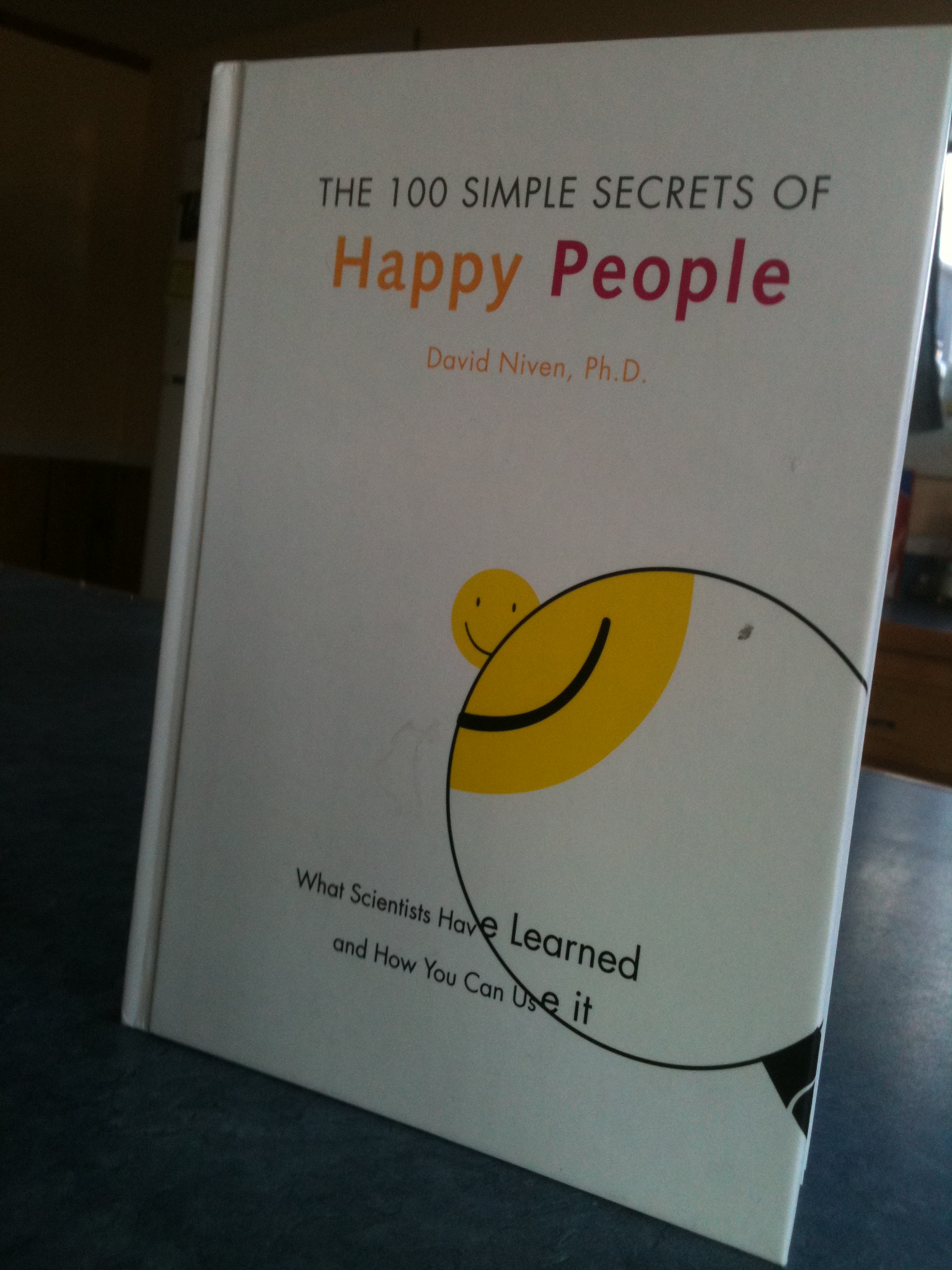
But happiness research, which started, oh, around the time of Aristotle, has found consistent paths to happiness.  Some of those ideas are captured quite pithily in a book my sister Peggy sent me, The 100 Simple Secrets of Happy People: What Scientists Have Learned and How You Can Use It,” by David Niven, copyright 2001.    For example, # 16 is “Believe in Yourself.”  #17, however, is “Don’t Believe in Yourself Too Much.”  Gotta love it.

In England, the New Economics Foundation — originators of the Happy Planet Index — has developed five keys to happiness: lifelong learning, connection with others, mindfulness, physical activity, and giving to others.  There’s a lot of good information at their website.

The Pursuit of Happiness project — a group of academics with a mission of teaching us all to be happier, has seven correlates to happiness: relationships, caring, exercise, spiritual engagement, positive thinking, flow, and strengths and virtues.  Click on the science of happiness tab at their website  http://www.pursuit-of-happiness.org/ for a fuller explanation.

Bhutan‘s Gross National Happiness policy grid for determining whether policies will actually lead to greater well being for the Bhutanese has nine pillars and 72 indicators. Most of these measurements fit well with our western culture.

Much more simply, I recently read that there are just three happiness fundamentals: feel good, do good, and be good.  Voila!  That’s all there is to it!

Happiness Inspiration Cards

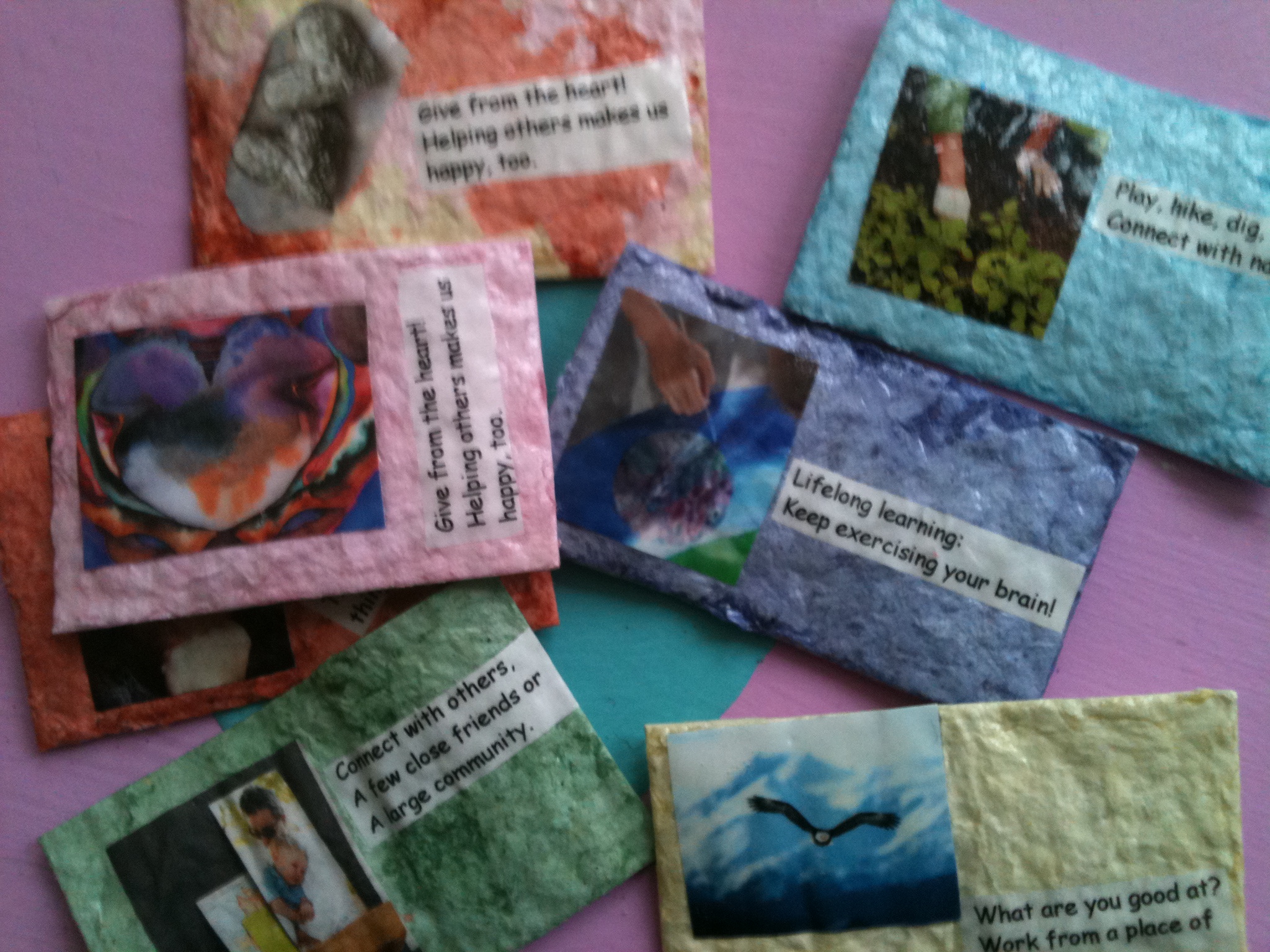
I’m not a scientist or an academic, but based on my reading (including all the fine resources above), I’ve developed my own list of 18 happiness tips that are, hopefully, both accessible and personally meaningful.  I’m embedding these tips in handmade paper, illustrated with snippets from magazines and catalogues, that I turn into happiness inspiration cards and greeting cards. Here’s my list, in no particular order:

1. Connect with others: a few close friends, or a large community.

2. Eat well, & get a good night’s sleep.

3. Give from the heart! Helping others makes us happy, too.

4. There’s so much to be grateful for!  Be sure to say thanks.

5. Stay physically active. Take care of your body!

6. Play, hike, dig, breathe, swim, ski: connect with nature.

7. Get in the flow: create, exercise, sing, concentrate.

8. Measure your happiness.  Truly! We focus more on things we measure.

9. Foster a positive outlook.  Optimists are happier!

10. Resilience: bounce back when bad stuff happens (‘cause it will).

11.  Be creative! Write, garden, solve problems, paint, dance, cook!

12.  Be a lifelong learner – ie, keep exercising your brain!

13.  Mindfulness: Be aware of the world around you, and within you.

14. What are you good at? Work from a place of strength.

15. Happiness is universal AND unique. What makes YOU happy?

16. Tread lightly on Earth.  If Mother Nature ain’t happy, ain’t nobody happy.

17.  Have a purpose. A meaningful life is a life with meaning.

18. Nurture your spirituality, whatever that means to you.

Phew!!  So many ways to be happy!  I’m sure you all have more, and I would love to hear what they are.