Genuine well being for ourselves and the planet

Archive for the ‘Personal Happiness’ Category

Social Comparison: The Cause of So Much Unhappiness

(Warning: the post below does not necessarily show off the author’s finest qualities.  Even worse, I’m hoping you’ll see yourself in these behaviors, because awareness of the unhappiness caused by constantly comparing ourselves with others is the first step toward freeing ourselves from social comparison’s grip on our psyches [and wallets].  Furthermore, since social comparison is a root cause of much environmental devastation, loosening its grip is good medicine individually AND collectively.  But never fear.  If you make it to the close of this little essay, you’ll find some ideas for breaking free or at least harnessing social comparison for the better. )
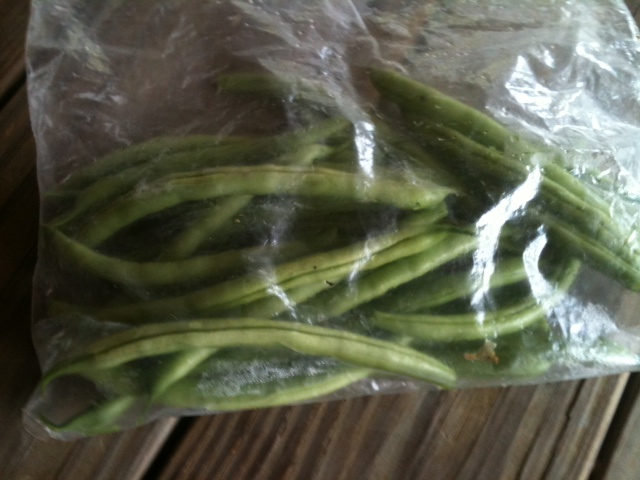
Mary Jane's extra beans.

Mary Jane’s extra beans.

Last Sunday evening, my friend Mary Jane brought a bag of extra green beans from her garden to share with other attendees at our weekly meditation gathering.  I gratefully accepted half the bag (there was one other taker) as Mary Jane enthused about how well her vegetables are growing this summer.

My garden is NOT doing well.  We’ve never bothered with a fence, but after this year — as all the peas and various other vegetables get eaten by unknown wild animals — we’re starting to think that might be a good investment.  Even my blueberries, which thrived last year, had a lackluster summer.  Could it be because I was a lackluster weeder?

In fact, the blueberries are my only crop.  Unlike almost all my women friends here in Vermont, I am a sorry excuse for a gardener.  Comparing myself to them … I just have to keep my mouth shut and not let anyone know I’m really not in their league.   I hardly ever even come to the ballpark.  It’s embarrassing.

My husband Bob is the real gardener of the family.  Speaking of my husband, he and I have both been trying to lose weight.  It’s discouraging to compare my progress with his, as he is doing significantly better than I am.  I am losing weight, but at our weekly check-ins, I am only down a few ounces,  while he can gleefully exclaim that he’s at a record low for the past five years.

Of course, I can take comfort in knowing I’m still doing better than our friends, another couple, who are part of this challenge with us.

Ugh.  What am I doing with all this social comparison?  Making myself unhappy, of course.  Why can’t I enjoy my husband’s success without also berating myself for my less diligent path?  And why can’t I just admire Mary Jane’s gardening bounty, accept her offer graciously, and not feel “less than” because I’m not a good gardener? And how pitiful to try and elevate my own self-esteem by noting that I am doing better than my friends — they’re my friends, for heaven’s sake.

Garlic social comparison

Not only that, but some of Bob’s gardening is yielding wonderful results.  He is harvesting another year’s worth of garlic, and the potatoes are doing better than ever.  His garlic bulbs are so big and succulent … I found myself looking at yet another friend’s just-harvested garlic and thinking, “your bulbs aren’t as big as Bob’s!”

What???  Petty, ridiculous, mean-spirited.  Okay, I’m not perfect — or as my friend Diana used to put it, “your halo’s slipping a bit” — but I don’t like this in me.  It is downright unpleasant.

Sadly, I could trot out an endless array of this kind of whiny, self-centered comparison — especially after I’ve left the comfort zone of central Vermont and spent time in an urban environment.  Then the flood gates of social comparison burst open, up and down, left and right.  I’m worse than because I’m wearing my sloppy Vermont clothes with my unkempt, non-trendy hair.  No, wait — I’m better than because I’m wearing my sloppy Vermont clothes with my unkempt, non-trendy hair.  It’s a lose-lose mindset.

As Sonja Lyubomirsky notes in The How of Happiness,” social comparison can be a pernicious destroyer of our happiness.  “You can’t be envious and happy at the same time,” she observes.  Nor can one be happy while disrespecting others.  While social comparison is inevitable and can serve a positive purpose — we can be inspired by others to do better ourselves — it is definitely a big problem for me.  I see it as the weakest link in my personal happiness chain.

Not only that, I believe social comparison is also at the core of many problems facing the planet as a whole.  Lord knows, advertisers play up social comparison to the hilt to get us to buy more stuff, which can have devastating impacts on our lives, the quality of lives of workers in far off countries, and the environment. I’ve shared this link before, and I’m sure I’ll share it again, but if you want a quick primer on how our hunger to “keep up with the Jones'” affects the world around us, check out Annie Leonard’s “The Story of Stuff.”

Even without looking at the bigger picture, social comparison can fuel endless wanting.  From the Buddhist perspective, that’s synonymous with endless suffering.

Naturally, Bruce Springsteen captured the tug of social comparison in one of his songs.  In “Badlands,” he sings, “Poor man wanna be rich, rich man wanna be king, and a king ain’t satisfied till he rules everything.”  There you go — social comparison all the way around.   I used to compare my poor husband’s arms with the super-buff Bruce, but even while doing so, I knew it was totally unfair to compare my real life regular guy with a mega-celebrity.  Yet, how many people get caught in the trap of comparing ourselves with celebrities — favorably or unfavorably?  I suspect it’s a major cause of unhappiness.

Even in the virtual world, social comparison can be a real downer: last year, a University of Michigan study found that Facebook makes users sadder.  According to an NPR report, research co-author John Jonides, a cognitive neuroscientist, noted:  “When you’re on a site like Facebook, you get lots of posts about what people are doing. That sets up social comparison — you maybe feel your life is not as full and rich as those people you see on Facebook.”

Happily — really, literally, happily — we can loosen the grip of social comparison.  A few suggestions follow.

First of all, turn it around — I/we can look at ways that we’d like to improve and see if there are others who inspire us.  For example, I wonder about all the ways I can help stave off (or at least ameliorate) climate change.  I know we need big systemic change to do this effectively — and, at the same time, I know that there are many, many small steps each of us can take.  To find out what others are doing,  two days ago I started a new Facebook group called, “Saving the Planet One Small Step at a Time.”  Already, I can compare myself to those who are using very fundamental cleaning supplies (plain baking soda and apple cider vinegar instead of store bought shampoo) and with a friend of friend whose blog, “The Non-Consumer Advocate,” focuses on ways we can all end our soul and planet destroying wasteful consuming ways.

I want to compare myself with these folks — they help me aspire to do better.

Even here, though, the comparison needs to be thoughtful.  Recently, when a post showed up on Facebook about a recent study showing that Vermonters spend less time grooming themselves than residents of any other state, I was quite pleased at this distinction.  So were many of my Vermont friends.  One could argue that this shows a heightened connection with nature and an awareness of the chemicals in cosmetics, etc.   Or … could it just be unhealthy Vermont exceptionalism?  I’m not sure.

Sometimes, I strive to be the one others look up to.  When I’m teaching meditation classes, I try to lead by example (ie, meditating every day).  When I mediate, I work at being the calm eye in the midst of a raging conflict storm.  Like most mediators, I try to model productive conflict strategies.

Here, too, it is important to be self-aware.  We are all on journeys.  I myself have a lot to learn about meditation.  And I also can get caught up in personally challenging conflicts.  Even while modeling, I need to remain humble, which is not easy.

Second, we can reframe how we view our own situations.  For example, I have a lot of social comparison issues with my house.  All too often I look at others’ homes and think, I wish I had your house, not mine.  Yet my house has many wonderful aspects.  As a former barn, it is unique, special, interesting, artsy, roomy, and comfortable.  My house is situated in the heart of a thriving, supportive community and across the street from a beautiful Vermont lake.  It is not perfect.  Neither am I.  Lately, when I catch myself obsessing about my house’s shortcomings, I try to reframe my thinking to focus on all its plusses instead.

Third, if you catch yourself thinking that your house — or whatever else — is better than, that is a fine time to practice gratitude.  Feeling grateful for is much more positive than feeling superior to.

Fourth, I’ll turn back to Annie Leonard and her more recent offering, “The Story of Solutions.”  On a personal level, on a systems level, can we turn away from “more” and focus on “better” instead?  Better choices, that is — not “better than.”  This simple formula for re-defining our goals is particularly powerful in curbing materialistic social comparison cravings.

Fifth, try making your own “Positivity Portfolio.”  I learned about this technique in the Certificate in Positive Psychology program I’m currently enrolled in.  Instructor Tal Ben-Shahar introduced us to this happiness tool, first developed by James Pawelski at the University of Pennsylvania.  The idea is to focus on a way in which you would like to change for the better, and then assemble a package of pictures, quotes, music, etc. — whatever stirs your heart and inspires you in this area.  I did a power point Positivity Portfolio on the theme of abundance, to counteract my social comparison tendencies.

At first the project was awesome!  I was so excited listing the abundance in my life, and finding photos to illustrate the list.  But then, the list got too big and the project dragged on and on.  It took me days to build my portfolio. I just have too much!  I mean that in a good way.  Clearly, life is incredibly abundant.  It was an excellent project.

Fifth, perhaps most importantly: meditate.  In order to loosen the grip of social comparison in our lives, we have to first develop an awareness of its existence within.  I can think of no better tool to heighten self-awareness than a regular meditation practice.  Meditation can also help us become more compassionate toward ourselves and others, instead of “less than” or “better than.”

My good enough bone builders sneakers.

My good enough bone builders sneakers.

In any case, despite what I wrote at the beginning of this essay, I think I am improving my ability to recognize social comparison creeping into my thinking.  When I recognize it, I am more likely to lean into my own abundance, and let go of envy.

For example, a few weeks back, during a Bone Builders class, I glanced at the shoes of the woman next to me.  This woman is also a friend, a lovely person who happens to have a lot more money than I have.  She had spiffy new shoes.  Not over the top, but very stylish.  Then I looked back at my own shoes, which are old, with a lot of mileage and one noticeable dot of teal paint on them.  It was a ripe moment for social comparison.  Instead, rather than covet my friend’s shoes — or even worse, resent her affluence — I found the whole situation humorous.  Kind of sweet, even.  My own shoes are just fine.  They do the job.  I like the paint spot.  I do not need to buy new shoes.  All is well.

One final thought: abundance comes in many guises.  True, it has not been a good year for my blueberries.  But there were enough berries this summer to go outside with my two year-old granddaughter almost every day and pick blueberries together.  This was a special activity for just the two of us, and it is a memory I can savor forever.  That, my friends, is abundance.



Gross National Happiness:Now It’s Getting Personal

Breastfeeding-004

As a co-founder of GNHUSA and one of the organizers of last month’s conference, “Happiness and Wellbeing: Building a National Movement,” I obviously endorse the efforts to adopt a Gross National Happiness (GNH) paradigm.  And I have more than a basic understanding of why what we choose to measure can exert such a powerful influence in our lives.

Nonetheless, I felt a real jolt of personal understanding during Gwen Colman’s keynote speech on happiness and public policy at the ccnference.  Gwen,  who developed the Youth Program at GPIAtlantic (a non-profit research and education organization that created a Genuine Progress Index for Nova Scotia), was contrasting what gets counted under a Gross Domestic Product (GDP) paradigm with what doesn’t get counted — and, therefore, doesn’t count.   First, she showed a slide of baby getting a bottle.   According to Wikipedia, the worldwide baby formula industry is worth an estimated $7.9 billion industry.  Certainly, there are many valid reasons why babies are fed bottles, and it is a blessing under any metric that formula is available when needed.  In any case, plenty of money gets exchanged, so bottle feeding counts.

Next up was a slide of a mom breastfeeding her baby.  How much money gets exchanged in that transaction?  Ergo, how much is breastfeeding worth according to GDP measures? Well, not quite nothing because there are nursing bras and breast pumps to be purchased.  But the actual act of breastfeeding?  That’s worth nothing.  Zero.  Zilch.  It doesn’t count.

This struck me personally because my daughter is currently a breastfeeding mom.  Watching my granddaughter thrive as a breast fed baby, I have no doubt that a GNH paradigm would enthusiastically endorse breastfeeding children to give them the best possible start in life.  But in our GDP-dominated culture,  my daughter has sometimes run into flack and disapproval when nursing her hungry or cranky daughter in public.  Despite laws in all 50 states supporting the rights of moms to breastfeed their children, many moms feel a kind of shaming pressure to hide this basic act of love and nurturing.  In January 2014, even a Victoria’s Secret store (of all places!) banned a mom from breastfeeding inside the store.  Perhaps if breastfeeding “counted” — ie, was included as something valuable in GDP measures — the public might be more supportive of this fundamental wellbeing activity.  This example underscores the pervasiveness of GDP thinking throughout our lives, and therefore the importance of GNH work on a deeply personal level.  Not all interventions to support greater happiness and wellbeing can or should happen at the governmental level.  Some need to happen in our own hearts and minds.

As an experiment, I spent one day last week examining my own activities, with an eye toward what adds to my wellbeing  and what counts under a GDP metric — you know, the kind of “positive” NPR is referring to when it relentlessly reports whether the GDP has gone up or down.  The GDP does not care at all whether money is spent for a positive or a negative — whether it’s a baby shower or a nuclear weapon, the only good here is money. So how did my day stack up, GDP-wise?  Not so good.  GNH-wise, though, it was a pretty wonderful day.

I began my day with a couple cups of coffee — good for the GDP, and, as far as I’m concerned, good for my happpiness, too.

Next came my daily meditation.  Because I like to play the Tibetan bells on YouTube in the background while I meditate, which means a little increase on the electricity bill which I’ll have to pay later, that was ever so slightly good for the GDP.  Plus I like to light a stick of incense — another wee boon for GDP.  But the bulk of my activity — a walking meditation around the house and out on the sunny deck — was cash free, and enormously good for my personal GNH.  Further, I’ll wager that my regular meditation practice may well save me money on medical care over the long term, as meditation may reduce the severity, or delay the onset of, expensive chronic conditions.  So really, my meditation practice as a whole is a negative on the GDP scale.

As I walked on the deck, I passed my husband’s laundry flapping in the breeze.

Letting the sun dry our clothes

Letting the sun dry our clothes

Using the sun and the wind to dry laundry is 100% worthless in the ruthlessly focused GDP metric.  Never mind that using a clothesline instead of an electric or gas dryer conserves energy and therefore does not contribute to climate change and other environmental devastation.  Never mind, either, that hanging laundry involves some physical effort, which is good for our health.  And then there’s that fresh air smell in clothes that have been hanging outside … worthless.

Indeed, in our GDP world, many jurisdictions and condo associations actually see clotheslines as a negative, and forbid them.  Vermont, I am proud to say, passed a law a few years back barring any such prohibitions.  In a world of pervasive GNH thinking, perhaps such laws wouldn’t be necessary, because we would be more aware of, and appreciative of, actions that are good for people and the planet.

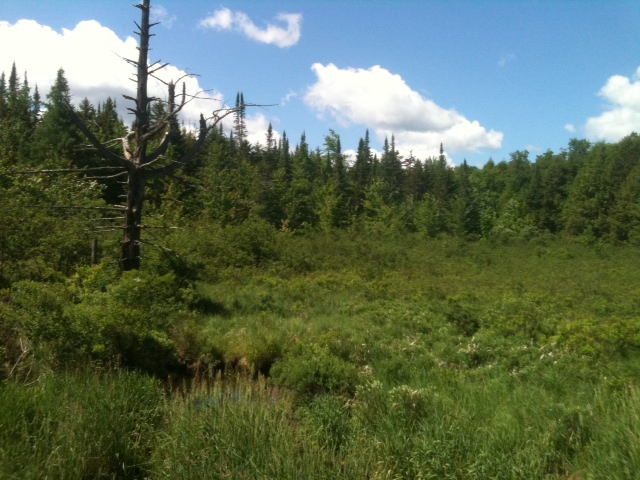
Next up for me was my morning walk on the three mile loop around my neighborhood, a walk that looks like this:

My morning view

My morning view 

And this:

Another view on my walk

Another view on my walk

… but counts for nothing, according to the GDP metric.  If I had chosen instead to take a scenic drive, burning fossil fuels and contributing to climate change, I might well have had to buy gas.  In GDP terms, that would have been a much better choice.

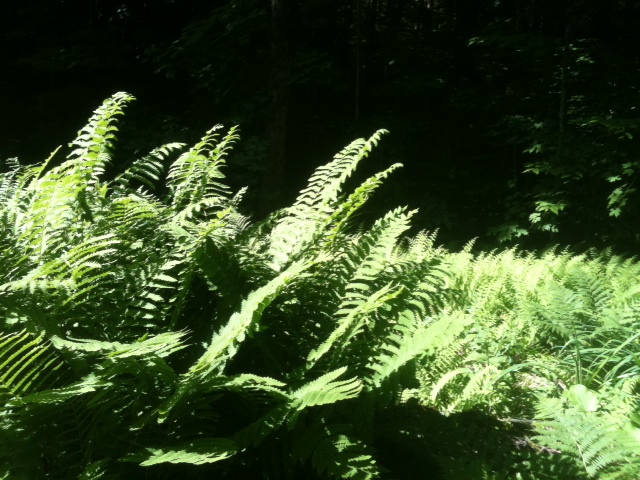
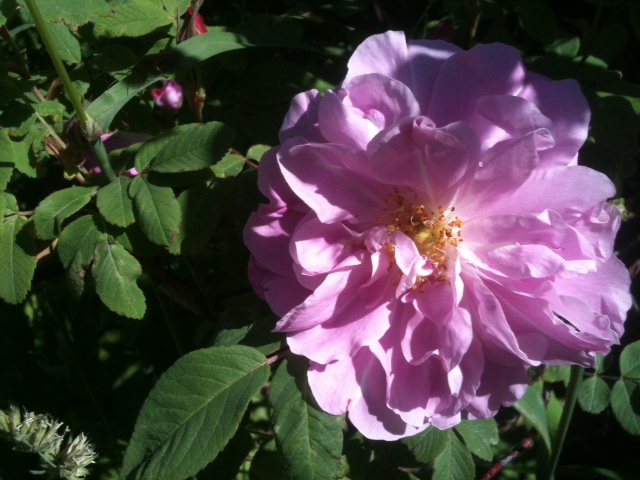
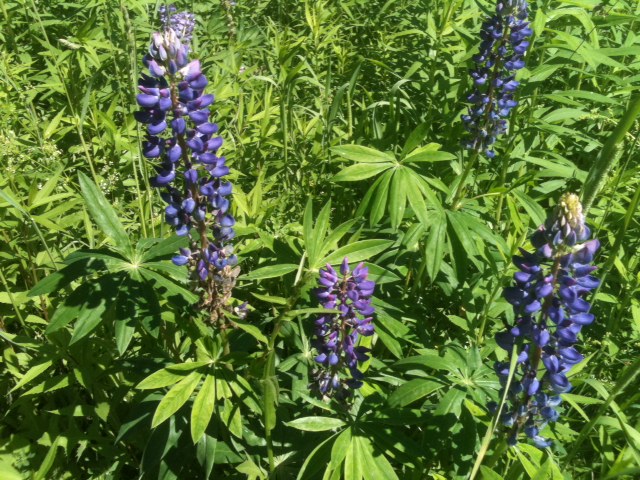
As I walked, on an admittedly exceptionally beautiful June day, I was struck by the profusion of ferns and wildflowers — so, so beautiful and so, so worthless if all that matters is the exchange of money.  I took a few photos:

Lush ferns ...

Lush ferns …

Wild roses, which also smell divine ...

Wild roses, which also smell divine …

Also in pink and white ...

Also in pink and white …

 Ever-cheerful daisies ...

Ever-cheerful daisies …

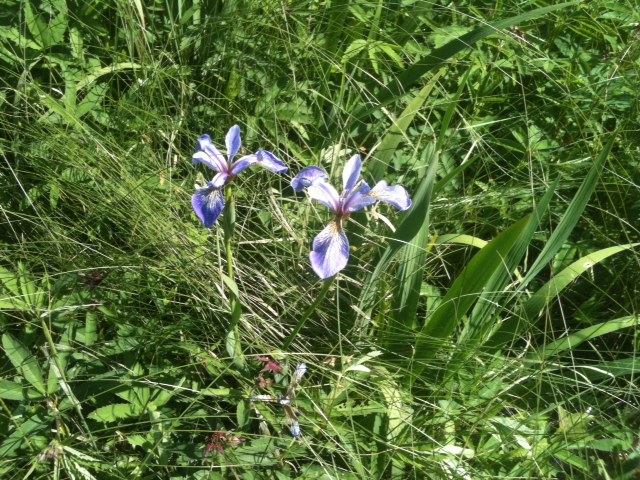
... and elegant wild irises.

… and elegant wild irises.

Taking the time to stop and savor these beauties and so much else that nature generously displays for us each summer is a tremendously valuable personal happiness booster.  And even though I’m not a naturalist, I know these flowers are important in the eco-system — important for bees, for birds, for life in general.  But the money is to be found in the flower industry, not out here by the road side in my back yard. Oh, no, cut flowers often have to travel long distances to arrive at their destinations.  Once again, according to Wikipedia:  many flowers are “grown far from their point of sale … (including) roses in Ecuador and Colombia, mainly for the US market, and production in Kenya and Uganda for the European market. Some countries specialize in especially high value products, such as orchids from Singapore and Thailand.”

Did somebody say, fossil fuels?  Peak oil?  Climate change?  But, hey, that’s a lot of money being exchanged — and that’s what matters, right?

With the worthless wildflowers on my mind, I took a look around my garden when I got home.  There were some annuals, some pansies that I had planted a few weeks earlier, definitely adding to the GDP:

My pansies, with a pinwheel.

My pansies, with a pinwheel.

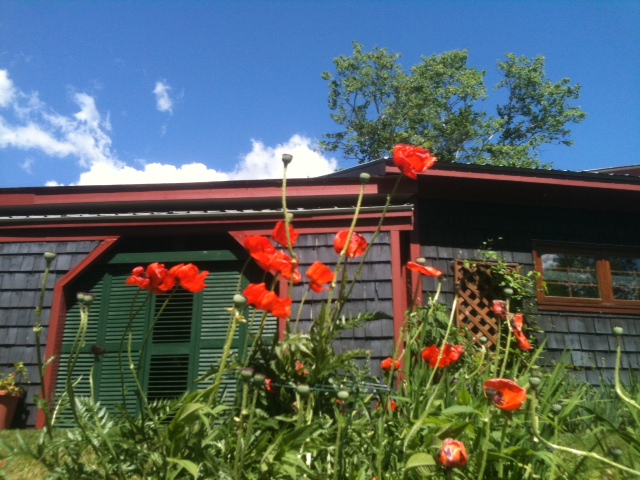
But even the flowers we plant have a limited GDP value.  Perennials only matter the year they are bought.  No matter how beautiful their blooms may be in succeeding years, they, too, become worthless — even in the hands of my neighbor Bev who coaxes these lush poppies and many other plants to bloom again and again and again:

Bev's poppies.

Bev’s poppies.

Okay, I won’t go on in detail about my whole day.  I did spend time writing (and playing Scrabble) on my computer (electricity again) and I received a check from a client. Both of these experiences were happy making for me in terms of working toward goals and having a purpose in life.  And both were of some value to Vermont’s GDP — not much, but still they count.

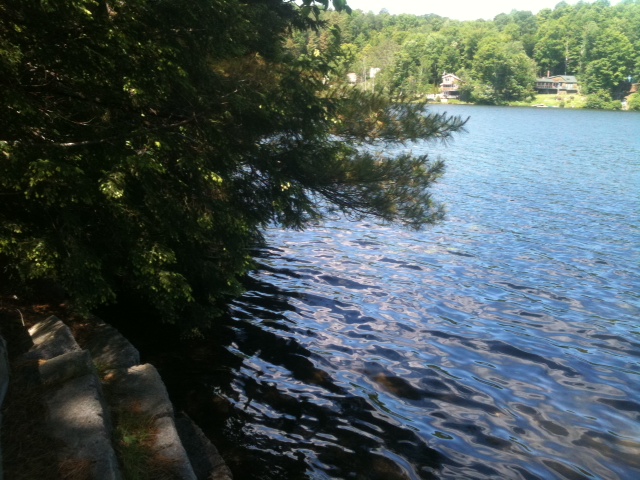
I can’t remember any more if I went swimming that day, but it’s certainly possible.  We live just across the road from one of Vermont’s many ponds and lakes, and often swim or kayak in this beautiful body of water:

The public swim area at our local lake.

The public swim area at our local lake.

Since there is no money exchanged when we dive into these waters, the GDP is not impressed with these activities.  Worse: since swimming and kayaking help keep us healthy, and that once again might mean less money spent on health care over the long term, this is another negative on the GDP side of the ledger.

Of course, if we paid money to go to a swimming pool, that would be good, GDP-wise.  And it would probably also be good, on a personal GNH scale– especially in the many, many months when outdoor swimming is not an option in Vermont.

Similarly, I love both libraries and book stores, especially our local independent bookstores.  I mention this combination because the final item of note for me on the day I paid special attention to my GDP footprint was a Facebook posting from one of my sisters.  She was alerting her neighbors that funding for their local library might be cut so drastically that their library would be forced to close.  Certainly libraries have value in GDP terms — payroll, building costs, buying books and magazine subscriptions, etc.  But all those books being borrowed at no cost?  Worthless!  I mean, sharing for heaven’s sake — how does that help the economy?

In a GNH world, would we be shutting down libraries?

Those are just a few snippets from one summer day.  I know I could — and hopefully, will — examine my life and my choices much more thoroughly.  What about you?  What is truly worthwhile in your life?  What brings you happiness, and increases your wellbeing?  How much of your life is needlessly tied up by what a GDP paradigm says is important and worthwhile?

As Gandhi said, we need to be the change we want to see happen in the world.  Want to see a shift to a gross national happiness metric on a large scale?  Perhaps we should all start by picking some wildflowers.


The Men in the Room Were Happy

My nerdy husband, happily vamping it up a few decades ago

My nerdy husband, happily vamping it up a few decades ago

Though it was a discouragingly cold early April night in Vermont, the six of us in my kitchen were warm inside and out, thanks to the wood stove, camaraderie, homemade pizza, craft beers, a scrumptious salad, and Victoria’s apple crisp.  We were full and comfortable.  Then, the three men got really happy.

Their joy began with a conversation about local contractors and home renovation projects.  Bob remembered a time he had proudly identified himself as a “trigonometrist” on a job site and proceeded to tell some fellow workers how to draw an ellipse.  “They said they were going to do it their way,” he recounted, “with wire instead of string!”

The other two men at our kitchen table laughed in great understanding.  Out came a napkin and pen, and a lively discussion about the proper way to draw an ellipse.  I thought, “A trigonometrist? Really?”  Plus, I was completely baffled about why anybody would care about using wire instead of string to draw an ellipse.   But I was loving their happiness.  All three men’s faces were totally lit up with enjoyment and engagement. They looked like little boys again.

Then I gazed at the other two women, who were both seemingly quite bored.  Since we were sitting in an alternate male-female pattern — two overlapping triangles — we were a perfectly balanced illustration of the fact that we all have different happiness boosters.  That night, the disparity fell along gender lines, but it could easily have been otherwise.  If the conversation had been birding or dogs, both of the women would have been animated while my husband and I sat silent.  Though, somehow falling along gender lines made it funnier to me.

The evening was also a fabulous illustration of what really keeps us warm during Vermont winters: community, and the criss-crossing relationships that are the foundation of a strong community.  The bonds of relationships were woven all through those two triangles.  From my point of view alone, I enjoy separate relationships with each person present that night: David and I team up on various social justice actions; Eric and I are in choir together; Victoria and I are part of the dedicated bone builders group; Judy and I share a passion for our local yoga class and meditation group.

Perhaps because Vermonters believe so strongly in community as a day-to-day guiding value, this state is one of a few “hot spots” of Gross National Happiness (GNH) activity in the country.  Burlington, Vermont was the site of the first ever GNH conference in the United States in 2010.  Now Burlington will host another conference, “Happiness and Wellbeing:  Building a National Movement,” on May 29th and 30th.  I’m pleased to say I’m part of the hard-working national core committee planning this conference.  I’m also pleased to let you know that there will be two days of trainings following the conference, including two full days of happiness skills training led by me and Barb Ryan, of “Spiraling Toward Joy” in Portland, Oregon.

In some ways, the planning committee and the conference itself remind me of the merry group having pizza and beer at my dinner table last month.  That is, what makes each of us uniquely happy is evident in the process.  I care deeply about systemic change, yes, but what really lights up my face is the opportunity to preach and teach the gospel of cultivating personal happiness skills.  So I get to focus my planning efforts on the first section of the conference, “Happiness Wellbeing: Skills and Practice.”  My colleague Tom, on the other hand, is passionate about data.  Thus, his focus has been on “Measuring Happiness and the Power of Data.”

I hasten to assure you, the planning team has not organized along gender lines!  Laura is a data maven right along with Tom, while Ken has been a key partner in planning the happiness skills segment.  Etc.  BTW, the other two segments are “Application: Policy and Community Development” and “Building the National Happiness Movement.”

So now the question is, what excites your passion?  Maybe you want to learn more about this amazing new movement.  Maybe you already have a lot of knowledge about why GNH measures matter so much to all of us, and are ready to get on the building a movement bandwagon.  Maybe you’re a data-head, maybe you’ve already applied a GNH-type paradigm to your community organization. Maybe you even know why you shouldn’t draw an ellipse with wire!

Whoever you are, if you’re still reading this blog, you are exactly the individual I am speaking to when I say, “I hope you’ll join us at the conference!”

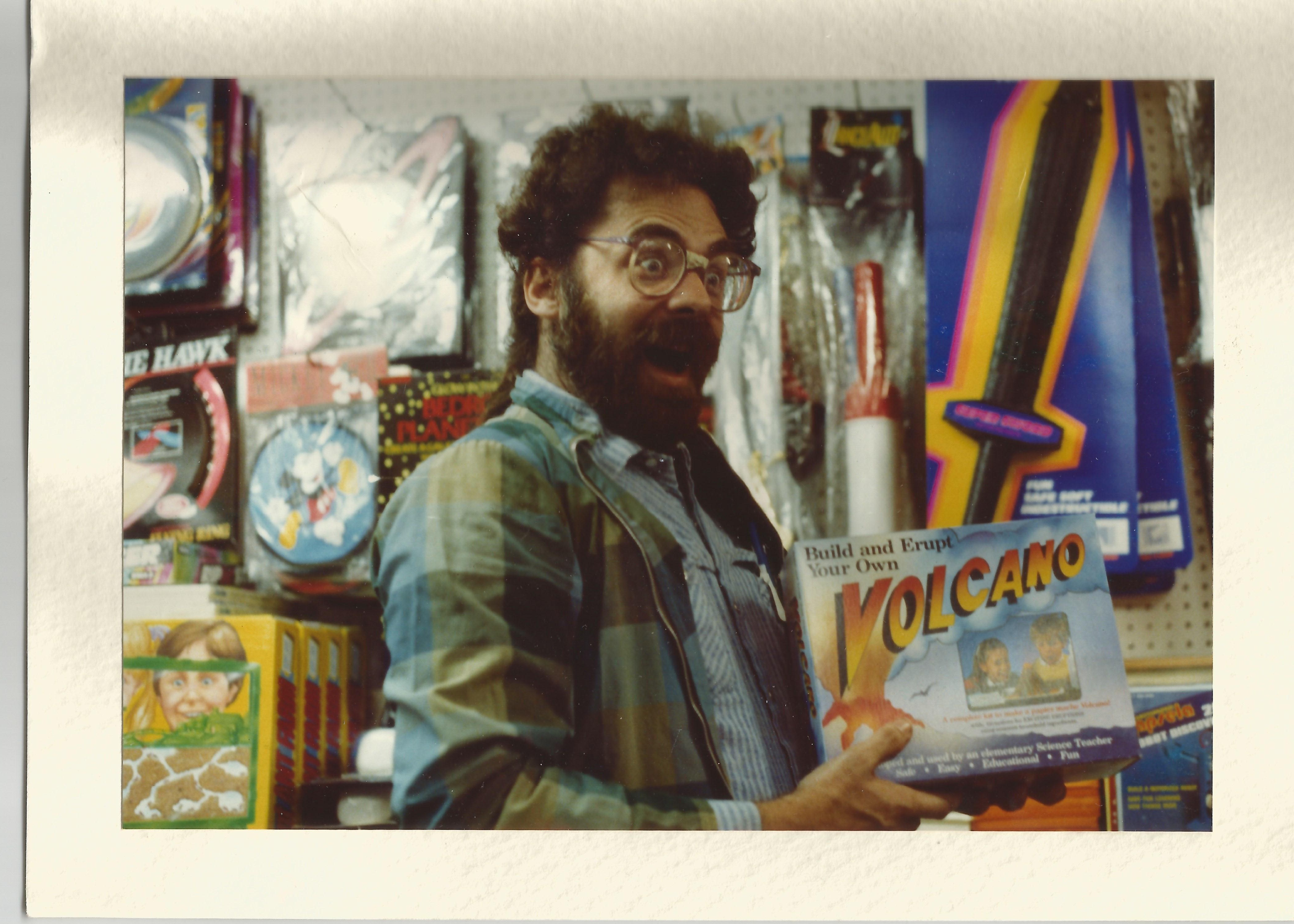
One final enticement.  Even more than drawing ellipses and build-your-own-volcano kits, playing the ukulele makes my husband Bob very happy.  He rehearses weekly with the Montpelier Ukulele Players — a group that has a whole repertoire of happiness songs which they will be performing as part of the Thursday night reception at the conference.  Sing along with them at one end of the reception hall — or dive deep into happiness policy discussion at the other end.  We’re all different, we’re all in this together, and we all want to be happy.


My Happy Bedroom

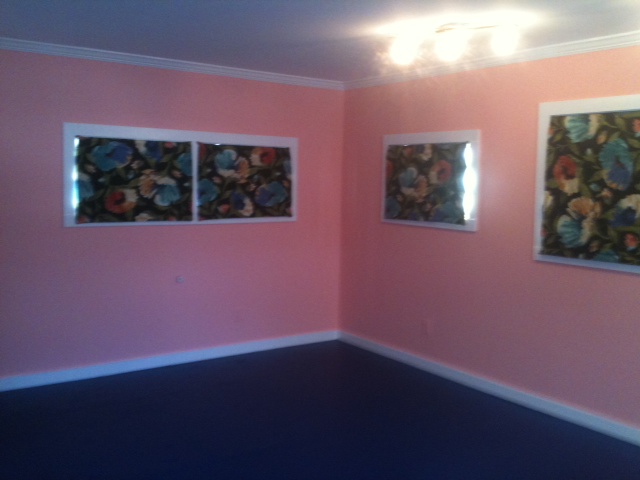
Our new bedroom, ready for us to move in.

Our new bedroom, ready for us to move in.

What if all the steps we took to help heal our hurting planet and wounded society (including, often, our own financial troubles in this era of inequity) were also steps that made us happier?

Though I’m an optimist, I’m also a pragmatist — so I think it’s highly unlike that all such actions will imbue us with joy.  However, I believe that coming from a place of greater personal happiness and positivity will enable us to much more frequently find creative solutions that add to the general well being and our own sense of contentment and pleasure.   Barbara Fredrickson calls this the “broadening” principle — through increased positivity, our minds can take in the big picture and thus we can see more options.

Such is the case with our new bedroom, which is making me so happy!  It makes me happy to go to bed at night, to wake up in the morning, to put my clothes away, to sit in the easy chair and read (right now, Martin Seligman’s Flourish).

I am, of course, enjoying the hedonic hit that comes from having something new and clean and pretty and a little bit exciting.  If that’s all I felt, I wouldn’t be writing about it.  No, what really pleases me is this: my bedroom is  a manifestation of our determination to live more sustainably and responsibly — and to do so in a joyful, colorful manner.

Here’s why we have a new bedroom. Our previous bedroom was on the third floor of our house, which is a converted dairy barn.  Three large floors, with big rooms, and lots of them, translates to depressingly large heating bills.  Last year, our propane bill became a huge burden for us to pay.  It also became unconscionable to me that we used so much propane, because I believe we all must wean ourselves off fossil fuels.  My happiness in having a cozy warm bedroom on the third floor of a drafty old barn came at a cost in dollars and potential human suffering that was just too high.

But what to do?  Often, my house feels like an albatross (I no longer find the idea of living in converted barn romantic).  Selling it doesn’t seem feasible right now, and fully insulating this dinosaur would be a mammoth, expensive task.   There seemed no good options.  Yetl one day last summer, I suddenly had a brilliant, Rube Goldberg plan.  Maybe this idea came to me because I’ve been working on my positivity for so long.  In any case, I realized that  I could move my art studio to the A-frame that had served as the Happiness Paradigm store, rent an office in town and move all my office work there, and then turn the first floor room that for so many years had been both my art studio and my study into our new bedroom.  Then, we could shut off the top two floors of the house (except when company comes) AND I can use my new in-town office to build a mediation and coaching practice in a much better location than a rural A-frame.  Perfect!

Let me tell you, all that was a lot easier said than done!  Clearing out a 12 year-old art studio took a ridiculous amount of time and emotional energy.  An old utility sink had to be hauled out, a very extensively “decorated” linoleum had to be ripped up,  walls painted for the first time since we moved there, and a new closet put in.  Fortunately, my son is also a top-notch carpenter and painter, so we could keep our spending very local!  Plus, he sealed the windows so the new room leaks far less heat than it did before.  And my amazing husband re-upholstered the frayed, old quilted curtains that pre-dated our arrival — so we “upcycled” what was already there, rather than buying brand new curtains.

Here’s something else that makes me happy now: when I have to run upstairs for something, all the rooms up there are COLD!

We still have a long way to go with this house.  We are now talking about replacing one or two of the individual propane heaters with pellet wood stoves.  We will have to take money out of our retirement funds to do this, and there’s not all that much there in the first place.  But just how expensive will propane be when we’re retired?  And how can we enjoy our golden years at the cost of others’ suffering?

Which brings me to Nova Scotia researcher Catherine O’Brien, whose work on Sustainable Happiness I admire so much.  She defines sustainable happiness as “happiness that contributes to individual, community and/or global wellbeing and does not exploit other people, the environment, or future generations.”  Like O’Brien, I believe deeply that we are all interconnected, and our individual pursuits of happiness must take into consideration our effect on other humans, animals, and the planet.  Re-doing my bedroom was not just about choosing paint colors — it was about choosing sustainable happiness.

Plus, it’s so pretty!  Meaningful and pleasurable — what a sweet deal.

Personal Happiness and Broken Systems

Periodically, I feel compelled to stress that my passion for spreading the happiness gospel is based on a fervent desire for a radically different political and economic paradigm — one that is focused on the genuine well-being of people and the planet, as opposed to a world which “has become an idolator of this god called money,” according to Pope Francis.  Like the Pope (I never thought I’d say that!), I “want a just system that helps everyone.”

The events last night that led to my granddaughter Madeleine taking care of her first ever baby doll have once again inspired me to write about the connection between personal happiness and broken systems.

My granddaughter practices nurturing relationships with her first ever doll.

My granddaughter practices nurturing relationships with her first ever doll.

My path is, of course, different from the Pope’s.  I believe that cultivating personal happiness is a key element (not the only element)  in working toward this shift.  Here are a few reasons why.  With greater understanding of personal happiness, comes a deeper appreciation of the sadness, emptiness, and destruction inherent in relying solely on Gross National Product  measurements of success.  When we internalize the knowledge that money and material goods are important but only a piece of our personal happiness, and also understand that chasing the almighty dollar can seriously undermine our enjoyment of life, we can so much more easily grasp the practical and visionary potential of a Gross National Happiness paradigm.

Further, cultivating personal happiness will strengthen the traits we need for the indescribably huge challenges of ameliorating climate change and ending the grown economy.  As we become happier individuals, we are, for starters:

  • less attached to things;
  • more optimistic;
  • more resilient;
  • more aware of what is truly going on around us;
  • more creative;
  • more compassionate: and
  • more grateful.

Oh, yes, and we are also more fun to be around — which no doubt makes us better messengers.

Okay, I’ll climb off the soapbox now and share what made me want to climb up there in the first place.  About a week ago, my daughter Jennifer’s old clunker car finally died.   She and my 20-month-old granddaughter will soon be joining us for a long Christmas break, but for a week and a half, she has had to cobble together a new transportation “system”: getting rides from friends, walking, and taking the bus.  She is fortunate to live in a city with decent public transit, but even so, last night my daughter and granddaughter spent 45 minutes on a cold, dark, and snowy Wisconsin night waiting for the bus to take them home.  It was pretty hard for Jennifer to be happy when her baby was crying from the cold.  My daughter sang to the baby to keep her calm until Jennifer’s cheeks were just too cold to keep singing.

Of course, the bus arrived eventually.  At home,  Jennifer decided it was a good time to open a Christmas present from Madeleine’s other grandmother.  That present is Madeleine’s first baby doll.   Watching her toddler practice taking care of this immediately beloved toy gave  my daughter a lot of reasons to feel much happier — gratitude, love, savoring the moment, etc.  So the story has a happy ending.

To me, this little vignette illustrates both the limits of, and the value of, personal happiness within broken systems.  For starters, cultivating our internal happiness is especially  important in the context of broken systems because, hey, this is the only life we get!  We should make the most of it, no matter the systems we live within.  I am so glad Jennifer and Madeleine got to end their evening on such a positive note.

To be clear, my daughter’s situation isn’t that bad.   She has a great job, a wonderful apartment, and a cousin who is helping her get a new car over Christmas break.  She’s only lived in Wisconsin a short time, yet she already has a group of friends who have been amazingly generous in providing rides.  Jennifer’s monetary resources may be limited, but she has almost an embarrassment of riches in terms of friends and family who love her and can help when help is needed.  Which brings me to another reason for cultivating personal happiness, a la nurturing relationships: it provides us the tools to build alternatives to systems that break.

But personal happiness has its limits.  My daughter’s transportation struggles inspired me to write about Gross National Happiness because of the millions of young parents — or old grandparents, for that matter — who struggle with transportation to school, work, and child care day in and day out, in broiling heat as well as frigid cold.  Their own fatigue and discomfort, intensified by their children’s suffering, may well make “happiness” seem like a ridiculous goal.  Not everyone has presents waiting for them at home, and there is no reliable car in the immediate future for untold numbers of America’s working families.  We do not have “a just system that helps everyone.”

And then there’s the obvious: we should all be weaning ourselves off fossil fuels.  A political and economic system focused on the well being of people and the planet would surely be moving rapidly toward excellent systems of mass transit.

Another obvious point: transportation is just one of our many broken systems.  That is why, this Christmas season, I will be spending lots and lots of time with my family and friends — giving and receiving, singing, playing in the snow, laughing, meditating, and doing my best to live a happy life.  At the same time, I’ll be working with my friends at Gross National Happiness USA and The Happiness Initiative to move towards a world of greater peace and justice, a world that does more than pay lip service to well being for all.

As Tiny Tim says, “God bless us, every one.”  Everyone.

And now I have to go bake cookies.

The Purpose of Happiness

Happy with a purpose: pushing the stroller!

Happy with a purpose: pushing the stroller!

I’ll admit to being just a wee bit clever with the headline.

That is, I’m mushing together two different happiness threads.  First, I want to share some current thoughts on why cultivating individual and systemic well-being is so vital.  Second, I’ve had some personal experiences and observations on Sonja Lyubomirsky‘s “Happiness Activity No. 10” — committing to your goals, or, having a purpose.

Why Happiness Matters      

There are, of course, a multitude of reasons why happiness matters, including sounder health, greater creativity, increased compassion, more personal success,and better parenting.  Perhaps because I’ve had a grand baby living in my house, I often think of Christine Carter’s book Raising Happiness and her emphasis on parents “putting on your own (happiness) oxygen masks first” to raise compassionate, joyful children.  Obviously, I want to do my part to help my grand daughter become a compassionate and joyful person.

Then there’s Aristotle’s quote:  “Happiness is the meaning and purpose of life, the whole aim and end of human existence.”  That is, all our other purposes in life are really in the service of happiness for ourselves and others.  Happiness is purpose in capital letters.

But what really made me want to write on this topic were three lines from a book I bought at Omega Institute in Rhinebeck, New York last month.  The book is Happiness by Thich Nhat Hanh. It contains a variety of mindfulness practices to “fully enjoy life’s gifts.”  In the intro, the Buddhist monk writes, “Every step and every breath can be an opportunity for joy and happiness.  Life is full of suffering.  If we don’t have enough happiness on reserve, we have no means to take care of our despair.”

A few days later, the urgency of cultivating both personal happiness and a societal Gross National Happiness paradigm struck me as I listened to a National Public Radio story on how warmer temperatures that come with climate change could lead to spikes in violence and fighting.

We have to figure out a better way to cope, and soon.  Here’s a goal: for the impossibly big stuff (climate change) and the smaller griefs (like the one I share below), let’s substantially build our happiness reserves.

If history predicts the future, happiness may well be key to positively and collectively adapting to change.  According to evolutionary psychologist David Lykken — one of the early modern happiness researchers — happiness is an “adaptive difference”  that during early human history at least “increased the chances of survival … improved one’s chances of maintaining and profiting from group membership (and) gradually separated our ancestors from the also-ran. ”  (Happiness, p. 14)

Perhaps, happiness will once again be a key determinant of human survival.  

Purpose as a Happiness Strategy

Unlike our ancient ancestors, we can benefit from researchers like Lyubomirsky and their guide books for our individual happiness journeys.  In The How of Happiness, Lyubomirsky details 12 happiness activities; number 10 focuses on goals.

She starts that chapter with a quote from Australian psychiatrist W. Beran Wolfe, written in 1932: “If you observe a really happy man you will find him building a boat, writing a symphony, educating his son, growing dahlias in his garden, or looking for dinosaur eggs in the Gobi Desert.”  Or, as Lyubomirsky more succinctly put it, “Find a happy person, and you will find a project.” (p. 205)

My inspiration on this topic was closer to home, and very 21st century — a walk several weeks ago with my 15 month-old granddaughter Madeleine.  She and I were returning from the neighborhood labyrinth about a mile and a half away.  Though she contently rode to the labyrinth in her stroller, on the way back, she started fussing.  For some reason, I asked her if she wanted to help push.

Boy, did she.  It was hot and we had a long way to go, but that little girl was determined to “push” the stroller all the way home (with grandma’s help, of course).  Because I knew she was exhausted, I tried repeatedly to convince her to quit pushing and relax in the passenger seat.  No way.  She had a purpose, one that clearly fed her happiness in that moment.  Though she is too young to articulate goals, if she could, I’m sure she would have said her goal was to push the stroller to our front door.  In fact, she diligently and doggedly pushed for more than a mile.  Looking down at her little body working so hard was a poignant sight — and a lesson in the value of purpose.

Lyubomirsky cautions that no happiness strategy will resonate with everyone, and that is true even within my immediate nuclear family.  Unlike Madeleine, her grandfather (my husband Bob) is not goal oriented.  He always has many projects going — he’s just not in a hurry to finish anything.  Earlier in our marriage, Bob’s lack of purpose upset me.  I’d press him to articulate his goals, and he would panic because … he basically doesn’t have any.   Yet, he’s content and happy.  Part of my lifelong learning was to recognize that he is who he is, and one of my goals should definitely not be to change him.  Similarly, Madeleine has always been a determined and focused little being; I wouldn’t even dream of trying to change her!

As for me, purpose not only helps define my most satisfying days, it is also a reliable coping strategy* when life isn’t working the way I’d like — for example, dealing with the smaller grief I mentioned above.  Just a few days ago, my beautiful daughter and granddaughter — who came to live with us when the baby was only five weeks old — moved to a distant state.  The move is a good thing, and definitely meets my daughter’s need to have a purpose (teaching university students).  I’m happy for them.  Nonetheless, I was very, very sad when the moving van drove away.   Everywhere I looked, I saw memories of Madeleine and our precious year and a half together.

Fortunately, I also saw projects everywhere.  I cried awhile, and then tackled my oppressively messy clothes situation.  Two days later, I had one bag of clothes to donate to an artist friend who will re-purpose the material beautifully; two large trash bags filled with clothes to donate to the Goodwill; one trash bag filled with items that just needed to be thrown away; and a much, much neater closet and dresser.  Best of all, I felt better.  This project helped me say goodbye to the past and turn toward the fun times my granddaughter and I will share in the future.  It was soothing, and settling.

Since June, I have co-facilitated a happiness study group designed to help each participant determine which which strategies from The How of Happiness will best make each of us happy.  It’s been clear to me for some time that spreading happiness is one of the most fundamentally important purposes of my life.  Now, I also appreciate just how much having a purpose and pursuing my goals deepens my own happiness.   It is comforting knowledge.

____

* Developing coping strategies for challenging times is another of Lyubomirsky’s recommended happiness activities.

Keep On The Sunny Side

Has anybody actually seen the sunny side lately??

Here in Vermont, it has been raining almost every day for nearly seven weeks.  We have savored intermittent hours of gorgeous sunny weather, but even those heavenly days have usually been punctuated by fierce thunderstorms bringing down trees and bringing on flash flooding.

The soggy weather is bad enough in isolation.  After each long winter, we Vermonters love and crave our summers.  This year, though, it’s our plants that need more sun.  It was a bad year for strawberries.  Most of my friends proudly grow a big vegetable garden each year; today, some of their veggies are drowning.  Then there is the intensity of the storms — frightening and unusual this far north.  We’ve had massive flooding in our little state, with roads washed away, houses seriously damaged, and at least one drowning.

On the home front, I’ve been feeling stressed and distressed about my son, who earns a good chunk of his yearly income painting exteriors during the summer.  He had lots of work lined up, but has been getting washed out day after day.  And then the next day and the day after that.  He’s not earning much money, and it’s discouraging to be idle for such long stretches.  He tries to keep summer rain in perspective, knowing there’s nothing to do about it — but his attitude has been severely strained by this seven week wet stretch.

One of the kindness cards I made to create more internal sunshine.

One of the kindness cards I made to create more internal sunshine.

I know there are many more Vermonters out there, in various jobs, who are really suffering financially from the weather — including, of course, farmers.

Which brings us to the bigger picture.  If this is  this the new face of climate change in Vermont, how will we grow our food?  Too much rain seems less frightening than not enough rain, but unrelenting storms could devastate our food supply.  I keep thinking about Barbara Kingsolver‘s book, “Flight Behavior.”  I won’t spoil the ending, but there is a lot of rain in her brilliant climate change novel — and it’s not a pretty picture.

Talking about this with friends and neighbors … there’s a certain amount of jitteriness and foreboding.  Listening to the radio is no better.  Whether it’s the local Vermont Public Radio or National Public Radio with shows about such topics as Antarctica melting and the doom this spells for Miami, there is plenty to weigh down anyone with their eyes open.

And now, back to our regularly scheduled happiness talk …

I’m willing to allow myself some time here and there to feel blue, discouraged, frightened, etc.  Overall, however, I think it’s more important than ever to Keep On The Sunny Side.”   Watching and singing this inspiring bluegrass song by the Carter Family — performed here by The Whites — puts a smile on my face and lifts my spirits.

Perhaps because of all the rain, this song about sun (mostly metaphorical) has been very much on my mind.  Last Sunday, when I had the opportunity to do another guest sermon at the Washington, Vermont Universalist Church, I chose this song as one of the hymns.  On Monday and Wednesday, I introduced it to the local  bone builders group.  I’ve even been singing it to the grand baby.

This song has me wondering, how can I keep on the sunny side?  How can you?  I believe we’re all in for a rocky climate change ride, and we’re simply going to have to make the best of it.  Happier people are more resilient, more creative problem solvers, and more optimistic — all much needed traits today and in the months and years to come.

Which is why I think it’s so important to understand how to cultivate genuine happiness, and then do that.  So, yesterday, after hearing about how Miami will be under water in the not too distant future, and worrying that my son won’t be able to pay his rent, I decided to focus on happiness.

First, I worked on making kindness cards fashioned from recycled paper slurry and donated and/or salvaged odds and ends.  My plan is to pass these cards around to strangers.  I’m not sure exactly when or how that will happen, but the act of creating the cards made me feel kinder — and, happier.

Second, having a purpose is vital to happiness.  I’ve just come up with a plan for using far less propane in our house — thus, helping us be more resilient to climate change fall out while also lessening our own contribution.  This plan will involve  a lot of work as we reconfigure how we use and heat our home — but I’m excited by the goal!  I’m ready to dig in and get started.

Third is exercise.  Yesterday morning after swimming in the lake, my grumbly self almost skipped bone builders.  I didn’t have time to eat breakfast or change clothes, but I knew I’d feel better afterwards if I went.  So I went to the community center still in my wet suit and had a great time with my fellow bone builders — including singing “Keep On The Sunny Side” to some back leg lifts (with ankle weights).  And I did feel better, thanks not only to the exercise but to the community of women sharing this experience.  Last night, though no yoga teacher showed up for our usual Wednesday night session, the three of us who were there created our own workout — and community — and it was great.

There is more, of course, but those were the big three that helped me get my happiness equilibrium back yesterday.

And today?  The sun actually came out by noon.  It is glorious.

It’s Vacation Time! Is Everybody Happy?

This Memorial Day weekend it was snowing at my home in Vermont, but now that the sun is out — and we’re supposed to get 80-degree temperatures in a few more days — perhaps we can relax and believe that summer is finally here.  For many of us, in addition to pulling endless weeds, summer means vacation!  Will those vacations make us happy?

According to research, yes.  A February 2010  New York Times article  reported on findings from the Netherlands that vacations do in fact make us happier, if nothing goes wrong, like an illness or a fight with your spouse.  The Dutch researchers found that the biggest happiness hit comes from anticipation.  We can also savor the joy of vacations in the present moment.  Not only that — Sonja Lyubomirsky notes in The How of Happiness that we can savor these experiences in retrospect, especially with the aid of photographs.

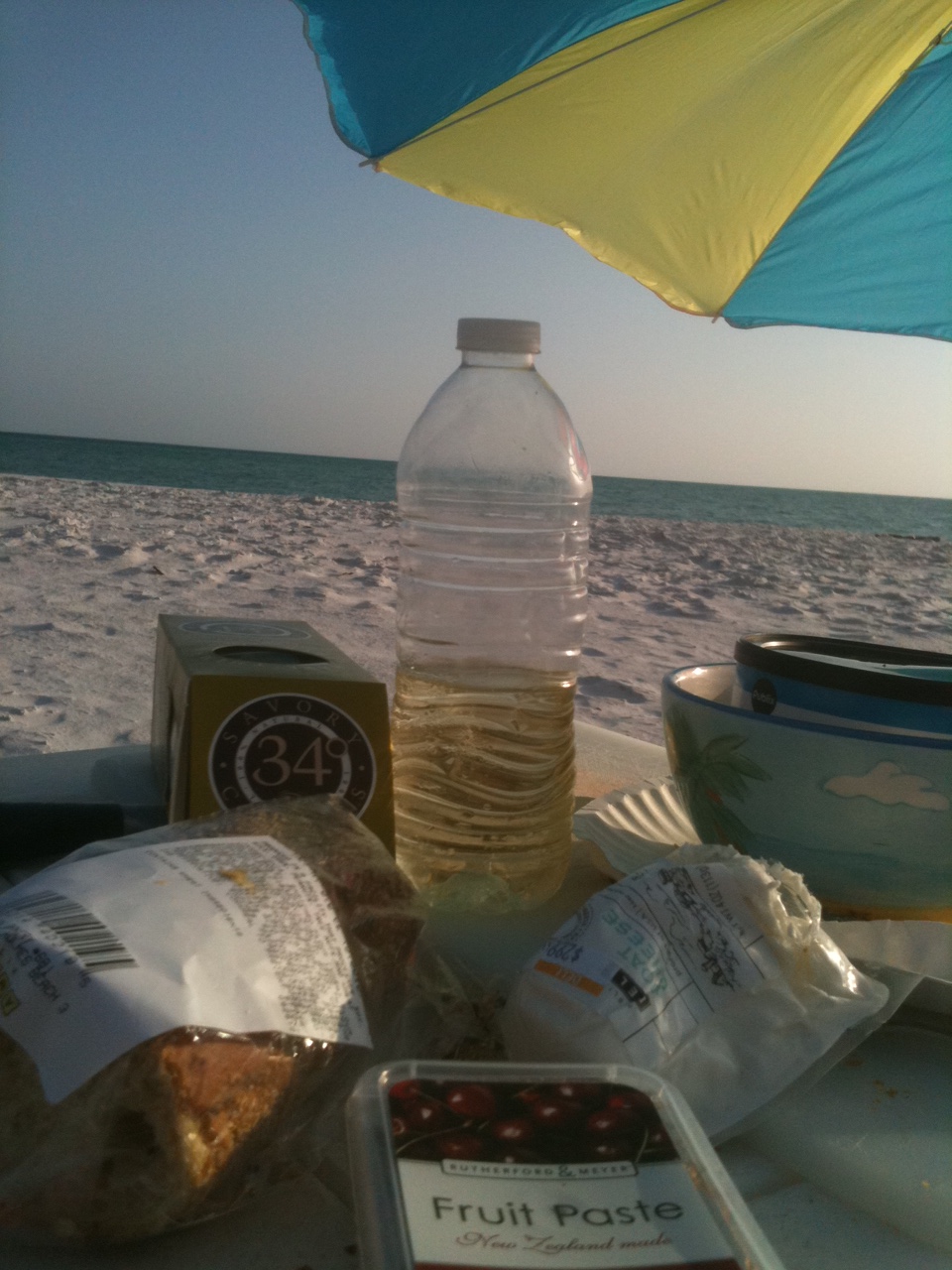
A very happy evening with a simple but savory meal on the beach.

A very happy evening with a simple but savory meal on the beach.

Okay, that’s the research, that’s the theory.  But how does it work in “real” life?  This has been on my mind because a month ago, when I was returning from a blissful week long stay at the beach, I was not happy.  Rather, I was close to tears — and a little bit angry, too.

The anger — or maybe it was resentment — was toward those (temporarily?) fortunate souls who were just arriving on the island and toward those with the financial resources to afford second homes and lots of time in this heavenly spot.  I felt like living proof that our country’s extreme income inequality breeds unhappiness.

I also felt spoiled, petty, and not very highly evolved for even thinking in these terms.  First of all, the trip was an amazing Christmas present to me from my very loving husband, and throughout the week, I was filled with gratitude for him.  But the desire to stay longer overwhelmed me with sadness.  Ah, desire — the cause of so much suffering!

Further, I know that comparing ourselves with others is insidious and a sure fire recipe for unhappiness.  Yet there I was, comparing away, and finding myself very much wanting … Never mind that I was still in a warm, sunny, carefree place while most of my friends were stuck in climates where winter just wouldn’t let up.  Or, the much broader comparison with all the pockets of desperate unhappiness in the world.  I was looking at those with more money and more time than me, and that comparison was anything but cheer inducing.

I’m pleased to report, I’ve got my happiness equilibrium back and can look at photos and videos of the trip and feel joy.  I still long to return, but that longing functions more as an inspiration for me to take the steps I need to take to make that happen.  It’s now a goal, and goals can increase our happiness.  Can increase our happiness, or not — depending on the goal!

A month out from my sad state of desire and social comparison, I’ve landed on three thoughts: first, happiness is a process; second, the ground rules can seem murky sometimes; and third, never underestimate the value of a mindfulness practice.

A Lifelong Process: In my happiness workshops, I like to quote writer Margaret Lee Runbeck, who said, “Happiness is not a state to arrive at, but a manner of traveling.”  I also like to compare cultivating one’s own happiness with maintaining flexibility through a regular yoga practice.  It’s not something we can do once or twice and declare victory.  We have to stick with it to maintain our happiness muscle tone.

So maybe my vacation deprivation was a little teeny tiny example of income inequality — and maybe, much more so, I was a loud example of the need to maintain one’s happiness practices.  After all, I read about this field all the time, and I try to heed the wisdom of the great science of happiness thinkers.  Throughout the week, I consciously savored the experience, expressed gratitude, exercised, and even went to yoga class twice.

It wasn’t enough to carry me through the departure.  Guess I’ve still got work — a lot of work!! — to do on my happiness journey.

The murkiness of happiness practices: Driving home, I mulled over the complexity of happiness strategies.  For example, savoring.  Really, it was a sweet, sweet week — perfect weather, and we saw many wild animals in their own habitat (including a snake that liked our patio, and two manatees in a nearby canal) — with much to savor.  But, did that make it harder to let go?

Then there’s social comparison — obviously, a source of distress for me.   Yet, comparison with others can serve as a spur, providing us with the role models we need to follow.  For example, there was a lot of time for people watching on the beach, and I saw many fit bodies of all ages — an inspiration to me to be more physically active and stay as healthy as I can for as long as I can.  Envy may be destructive, but looking at a woman older than me in great shape, and thinking, “Wow, good for her!  Maybe I can do better, too!” seems very positive and an excellent motivation for long-term happiness.

Mindfulness: I’m beginning to think all roads lead to mindfulness.  It seems like any happiness question or strategy you examine includes a crucial element of awareness.  In this case, thankfully, I was aware and self-reflective.  While I felt bad for myself, I knew that was a) petty and b) temporary.

Mindfulness helps us make better choices.  I say that I now have a goal of getting back to this gorgeous island, but at what cost?  Do I focus on making money for a vacation rather than follow my true calling?  Do I choose a tropical vacation trip over a visit with my granddaughter?  Meditating helps me find the answers to these and an infinite number of other questions, big and small.

I also know that so much unhappiness can come from wanting.  Wanting, wanting, wanting.  And yes, that wanting can sometimes serve us, but more frequently it leads to unnecessary suffering.  A meditation practice is so crucial to building and maintaining an awareness of what really matters in life.

Meditation also strengthens our capacity for compassion.  In my sadness at leaving behind a week of joy, perhaps I could have had compassion for myself; compassion for those who get to spend more time on the island but undoubtedly have their own suffering; compassion for those just arriving for their week’s vacation and who might be as sad as me the following Saturday; compassion for my friends enduring a snowy April; etc. That’s a very big etc., and I’m sure you can fill in the many, many blanks.

The Dalai Lama has said, “If you want others to be happy, practice compassion.  If you want to be happy, practice compassion.”

I often practice a loving kindness (aka, compassion) meditation, but I did not meditate on this vacation.  I’m sure it’s natural to feel a sense of loss when vacation ends — the high of a good vacation is by its nature fleeting.  Still, I wonder if meditating while on vacation would have made departing an easier pill to swallow.  Hmmmmm … maybe I’ll give it a try next time.

The Happiest Jobs

Not so long ago, I couldn’t possibly have imagined I’d be writing a sermon.  While I may sometimes get preachy (ahem),  that doesn’t mean I ever aspired to the ministry.  Growing up, I never even went to church except on Girl Scout Sundays, when I felt very uncomfortable and out of place.

As an adult, though, I began to long for spiritual community.  When I decided to get a Masters in Mediation, I intuited that I could be more present and helpful to folks in conflict if I spent some time healing my own psyche.  This belief led me to the Unitarian Church of Montpelier, which has been my spiritual home since 2005.

When I finished my graduate degree, after devoting many months to studying the relationship between suffering and mediation, I bought a cheerier book: Dan Gilbert‘s Stumbling on Happiness.   It was a momentous purchase, as Gilbert’s book opened the gate to my happiness path.

On Sunday March 3rd 2013, the happiness path will wend its way through my spiritual home as I step into the pulpit as the guest minister at my church.  My sermon topic is, “Is Happiness Escapist, or a Valuable Spiritual Practice?”  (What do you suppose my answers will be?)

It isn’t unusual for members of the congregation to serve as guest ministers when our own minister Mara Dowdall  is away.  Nonetheless, I’m very pleased and honored to take my turn in the pulpit.

Even more exciting was receiving a second invitation to share my happiness sermon  — this time, from the Universalist Church in neighboring Barre, Vermont on Sunday April 7th.  I absolutely view pursuing happiness as a spiritual practice, so readily accepted this invitation as well.

Far left, my sister -- The Reverend Kathy Ellis, taking social justice concerns to the street

Far left, my sister — The Reverend Doctor Kathy Ellis — taking social justice concerns to the street.

But I do wonder, as I write the sermon, how the heck do my sister (Kathy Ellis, minister of the Unitarian Universalist Church of the Restoration in Philadelphia) and Mara and the other ministers I know do this week after week?  Writing a sermon is a daunting task!  And I know through my sister and through Mara that sermon writing is just the tip of the ministerial workload iceberg.

Lest you feel too sorry for them, though, I have to say the odds are good that they both love their jobs.  Indeed, in September 2012, Steve Denning wrote an article for Forbes on the “Ten Happiest Jobs.”  At the top of his list: clergy.  Denning notes, “The least worldly are reported to be happiest of all.”

Here’s the rest of his list: 2) firefighters; 3) physical therapists; 4) authors; 5) special education teachers; 6) teachers; 7) artists; 8) psychologists; 9) financial sales agents; and 10) operating engineers.

Only the last two seem at all surprising, though I think a lot of men I’ve known would love being operating engineers.  Says Denning, “Playing with giant toys like bulldozers, front-end loaders, backhoes, scrapers, motor graders, shovels, derricks, large pumps, and air compressors can be fun. ”  Yup, I can easily imagine my husband happily playing with these grown up toys …

Denning, who earlier wrote an article on the 10 most unhappy jobs, speculated that “the difference between the happiest jobs and the most hated jobs” is that “one set of jobs feels worthwhile, while in the other jobs, people can’t see the point.”  Makes total sense to me.

I also did a little bit of my own completely non-scientific research by asking my sister, Mara, and three other minister friends what about their jobs makes them happy.  Their thoughts follow.  But before you read what they say, pause for a moment to consider what the common thread or threads might be.  Some of what this group shared might surprise you.

Now, their responses:

Reverend Doctor Kathy Ellis:  “Ministry is about connecting – with people, with meaning, with the still small voice. It allows, almost requires learning and growth.  It is varied. Yesterday I even went to a movie as part of my work.”

Reverend Mara Dowdall:  “Some quick thoughts about what is ‘happy’-inducing: 1) meeting fascinating and lovely people and hearing their stories; 2) having the privilege to walk with people and be present for many holy moments; 3) reading poetry for work; 4) being challenged; and 5) variety: each day is different.”

Reverent Laelia Tawnamaia: “I agree with Kathy: love, meaning-making, justice advocating, creativity, flexibility, people, community, and soul growth.”

Reverend Susan Veronica Rak:  “I am happy in my work as a minister when all of me gets tapped into… I find all my ‘loves’ – story, art, creativity, beauty, weirdness, reverence, awe – come into play  in preaching, pastoral care, administration, etc. – and some of my greatest dreams and fears are in play, too. And that is what it is to be human.”

Reverend Janet Smith Peterman:  “It’s interesting that all of us are women and I wonder if that makes a difference. I think, too, that part of what is so satisfying is that I can use my creativity; the people connections are often at moments in their lives where something really significant is going on; we get to reflect on the larger sweeps of life and meaning; and, at least in the work I do, get to help communities find life/new life and redevelop.”

So, how did their answers fit with your expectations?  Certainly some of their responses were what I would expect (“holy moments” and “soul growth,” for example, as well as meaningful connections with others) — but what really struck me was the emphasis on creativity, variety, and continual learning.   It sounds very much as though they may frequently experience what Mihaly Csikszentmihaly describes in this TED talk as “Flow,” or “the secret of happiness.”

I also think it’s very significant that all five ministers described a variety of activities during their work days — activities that have also been proven to increase personal happiness.  Variety itself is a key to sustaining happiness, according to Sonja Lyubomirsky — mixing it up with our happiness activities keeps us interested and engaged in a way that is vital to continued higher levels of happiness.

Hmmmmm …. maybe I should pursue the ministry after all!  Just kidding.  Mostly.  Though I can definitely see the appeal in ministerial work, my calling in life is to preach happiness.  I expect to enjoy my time in the pulpit, but it’s definitely only temporary.

*****

By the way, for those of you who read my previous post on happiness for the goose and gander, I want to share my plan for “special music” on March 3rd: I’ve asked my husband Bob and his fellow ukulele players to perform “Bring Me Sunshine,” performed in this video by the Jive Aces.  This song always brings a smile to my face.  Perhaps you’ll enjoy it as well!

Gander & Goose Happiness

Right before the latest big blizzard, I read a post from a Texan who wrote that it was 60 degrees and sunny in his neck of the woods that day.  “Why would anyone ever want to live in the northeast?” he asked.

My internal response was, “Texas?  Really?  Are you kidding me?”  Large swaths of Texas have been on fire the last few years.  The state as a whole has lately suffered crushingly hot temperatures and frightening drought.  Why would anyone ever want to live in Texas?

As they say, different strokes for different folks.

When it comes to happiness, I suspect our differences emanate from a soul level.  Certainly each of us needs to chart our own distinct happiness paths.  As Sonja Lyubomirksy observes, “there is no one magic strategy that will help every person become happier.  All of us have unique needs, interests, values, resources, and inclinations that undoubtedly predispose us to put effort into and benefit from some strategies more than others” (The How of Happiness, p.69).

Or, in more folksy terms, what’s good for the goose is not necessarily good for the gander.  Or is it?

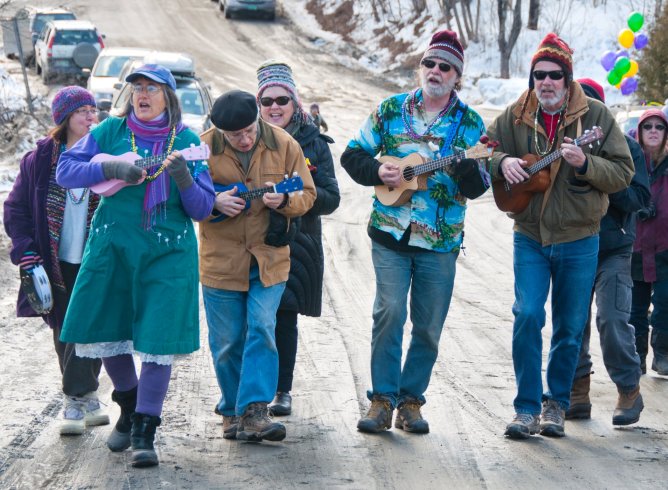
The Gander. That would be my husband, Bob.  This coming Saturday afternoon, he will undoubtedly get a huge happiness boost by once again leading his merry band of ukulele players in the Maple Corner Mardi Gras parade.  I’m guessing that getting into the flow of mastering the ukulele is partly why this experience gives him joy.  Also, I know he appreciates this opportunity to contribute to our community’s vitality.  Because performing makes his uke brothers and sisters happy too, by organizing this event, Bob further benefits by giving them this gig.

That's Bob in the Hawaiian shirt in the 2012 Maple Corner Mardis Gras

That’s Bob in the Hawaiian shirt during the 2012 Maple Corner Mardi Gras Parade

Plus, of course, it is just plain fun and not really something that needs to be analyzed.

The Goose is me.  I joined Bob in the parade last year, playing the only instruments I can even begin to handle (kazoo and tambourine); I may march again this year.  But, I’m excited about something radically different this coming Saturday morning:  a gun control rally in front of the Vermont Statehouse in nearby Montpelier.  Fun is not my strong point, alas.  I’m more in my element as a rabble rouser — or, as I might reframe it in positive psychology terms, I really like “having a purpose.”

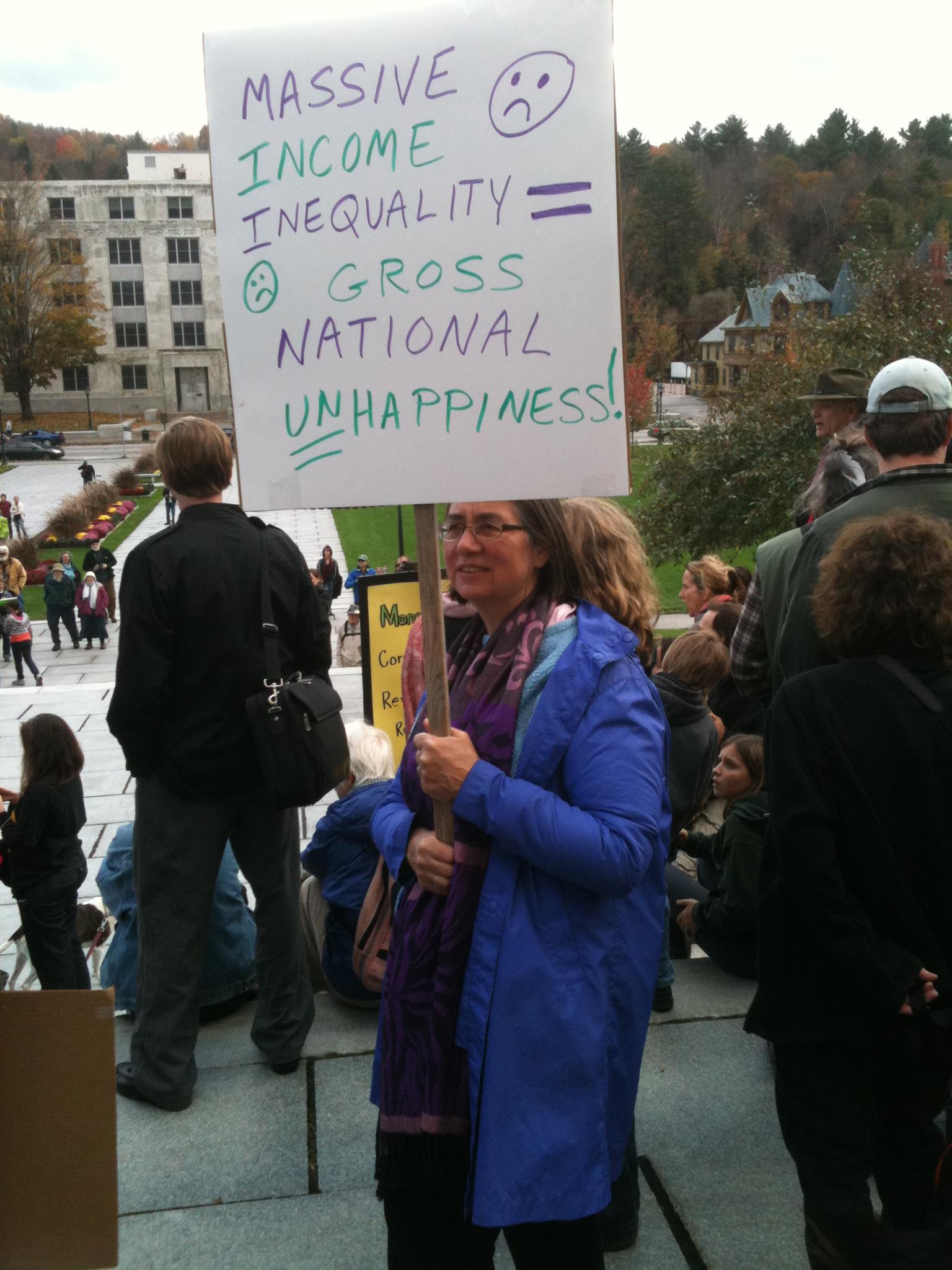
At the Vermont statehouse for a 2011 Occupy protest.

That’s me at the Vermont statehouse for a 2011 Occupy protest.

These differences between my husband and me play out most Sunday mornings.  While I head off to sing in the church choir and get a weekly booster shot of support in leading a good life, Bob heads for his ping pong club and several hours of very vigorous exercise with his buddies.  His table tennis time is just as sacred to him as my church attendance is to me.

These musings reminded me of the following section on the Pursuit-of-Happiness website about Martin Seligman and different levels of happiness:

“Seligman’s bottom line is that happiness has three dimensions that can be cultivated:

1. ‘The pleasant life’ is realized if we learn to savor and appreciate such basic pleasures as companionship, the natural environment and our bodily needs.
2. We can remain pleasantly stuck at this stage or we can go on to experience ‘the good life,”’ which is achieved by discovering our unique virtues and strengths and employing them creatively to enhance our lives.
3. The final stage is ‘the meaningful life,’ in which we find a deep sense of fulfillment by mobilizing our unique strengths for a purpose much greater than ourselves.”

Writing this blog, and looking at my husband’s and my choice of activities through the lens of Seligman’s three levels of happiness, I now see that what’s good for the gander can indeed be good for the goose — just not in the way I’ve interpreted this cliche before.  I always thought it meant the goose and the gander should be doing and liking the same things.  Now, I see that by doing and liking different things, the goose and the gander can help each other expand and enrich their levels of happiness.

Nearly everything I’ve read about what makes people happy stresses the importance of relationships, and good connections with others.  Perhaps one reason this is so is because other people inevitably provide us with more varied happiness opportunities.   We help each other cultivate different dimensions of happiness.

I definitely need to nurture “the pleasant life”  more.  Bob helps me be more playful, and that is definitely a good thing.  So … hand me a kazoo.  And see you at the rally.